
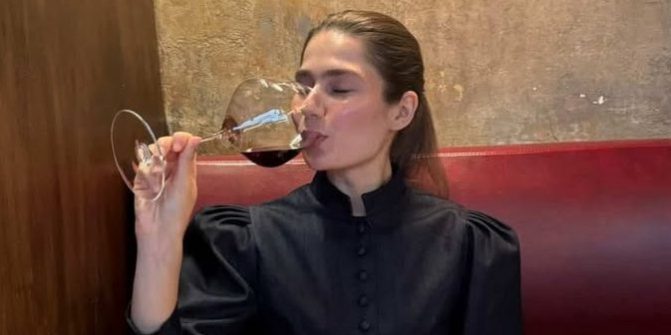
Cover photo provided by Emma Rayder
Emma Rayder (@ejrayder on Instagram) is a vintage fashion enthusiast and writer who has written for the likes of All Things Fashion Tech, Fashionista, Vogue Business, Teen Vogue, and more. She is interested in a plethora of topical fashion subjects, including AI, circular fashion, fashion tech, and resale. I recently interviewed Emma on my radio show, Pita Chip Chat, which airs every Monday of Winter Quarter 2026 at 11 a.m. on uclaradio.com. To listen to the interview in full, check out @andmore.archive on Instagram, where all show updates and previous recordings are posted.
—
This interview was conducted by Ava Bozic on November 3, 2025. This interview has been edited for clarity and brevity.
Ava Bozic: Thank you so much for joining me today!
Emma Rayder: Thanks for having me, Ava. It’s nice to speak with you.
Ava: You too. Since you’ve written for quite a range of publications, I want to know where your interest began or if you always knew you wanted to write.
Emma: I’ve always been very interested in fashion. When I was two years old, my mom would tell me that I would steal clothes from her closet and from my dad’s closet and make little outfits out of them. That translated into me wanting to become a designer. When I was in my elementary school era, I spent hours with a notepad, sketching designs, and I also always loved writing.
I went to school at the University of Virginia. It’s not the most creative-leaning school. I majored in English, and I graduated during Covid, so 2020. I didn’t really know what I wanted to do post-graduation, so I ended up working in financial communications [and] I actually still do that full time. I work a nine-to-five at a financial PR agency, but a few years ago, I realized that I felt pretty unfulfilled with my day-to-day life.
I’d always really loved writing, so I started to look into freelancing, and it took me about a year to pull together a portfolio and start pitching actual publications, but I got my start in a small publication based out of New York called Byline. From there, I started writing about music. I wrote for a music blog called Atwood Magazine for about a year, which I really liked. I love music. I’m not not good at music writing, I just found it a little more challenging. Criticism is hard. So I refocused my attention to fashion. It’s something I’d always wanted to do. I think a lot of young women and young girls dream about writing for Vogue one day, so I made that my goal.
I got my start in Teen Vogue with some culture pieces, and then I switched into fashion, and from there I found a niche in fashion tech. It’s been really cool because I feel like I’m growing with the industry. With AI really taking off in the past few years, there have been a lot of startups that have popped off, [and] I’ve gotten to speak with a lot of really impressive people. There aren’t that many reporters covering that space exclusively yet, so that’s been my journey.
Ava: That sounds awesome. That actually sounds very appealing to me, because I’m not studying English or Communications or Journalism, but I always had an interest in it. I feel like now it’s my hobby. It’s nice to know that there’s a way to always have writing or fashion in some capacity in your life. It doesn’t have to be the number one source of income. I’ve been trying to tell myself, “I can pursue psychology or whatever else, and still have another creative outlet.” I feel like a lot of people would be able to relate to desiring that creative outlet that you’ve created for yourself.
Emma: 100%. Freelancing is a really great way to go about writing it. Traditional media is very hard to break into now, and the jobs are pretty unstable. You’ll see a lot of newsrooms let go of their entire staff, or an entire portion of their staff, and it comes pretty unexpectedly. This has been a way where I do feel like I can express myself creatively, but it’s a little safer. I do think eventually there’s a good chance I will move further into the fashion space full-time, but I don’t know if that would be at a publication. I have thought about going back to business school. There are some programs, like NYU, that specialize in luxury and retail business, which I find interesting, so something like that or going to one of the fashion tech startups that I write about would be interesting as well. I do think that freelancing or doing something creative does open up doors that a traditional career path might not.
Ava: That makes a lot of sense. You said you work a nine-to-five, how do you find the motivation to continue to write?
Emma: Yeah, it’s hard sometimes. There are some weeks when, after my job, I just want to tune out and put on Netflix. I find that when I’m feeling that, I let myself have one of those days. If I’m really not feeling the urge to write, I will just let myself veg out, and I think that reset allows me to channel my creativity more. It does take a lot of discipline. Sometimes I just have to sit down and force myself to write if I have a deadline. Taking breaks, even if it’s small breaks, like going to the gym for 30 minutes if I’m facing writer’s block, really helps. But right now, I’m 27, I don’t have kids, I don’t have that many other responsibilities in my life. I’m trying to take advantage of this time. I’m working a lot, but I’m enjoying it.
Ava: How do you stay up to date with all these different topics? Especially the technical side, [does it] open you up to having topics to be inspired by more frequently?
Emma: Yeah, definitely. I follow a lot of Substacks [and] newsletters. I’m a really big fan of Puck; they have some great reporting. I love the Business of Fashion, Vogue Business, even Fashion Network; they’re under the Conde Nast umbrella and cover pretty much anything going on in the fashion industry. I find that they pick up on things really quickly so I try to scan their site pretty much every day. I have a running list of topics that I’m interested in, a lot of the time that comes up in conversation with somebody I’m interviewing, and I’ll make a note of whatever that topic is, even if it’s not relevant to whatever piece I’m writing at the moment. But, I could not possibly write about everything that I want to write about, because even if I wasn’t working full time, it wouldn’t be possible. I try to balance what I want to write about with the timeliness of it, obviously. When I’m freelancing and I’m pitching publications, it also depends if their editors want me to write that.
Ava: I don’t really know how the freelance space works. I know there are specific people that are editors for Teen Vogue, for example, or maybe dedicated writers to one specific publication. How does that work if you’re pitching [yourself]? Does it require a lot of outreach on your end, or, at a certain point, do people reach out to you?
Emma: Yes to both upfront. It’s a ton of outreach and a ton of rejection, and also just not hearing back at all. That’s probably the most frustrating. You just have to put yourself out there. Look at the masthead. Find the right editor for whatever you’re pitching. Make sure your pitch is good. Make sure it’s concise. Make sure it’s timely. If it’s not necessarily timely, like if it’s a longer form feature, just make sure it’s super interesting. I’m a total stickler on my subject lines; I always try to format them as a headline for whatever publication I’m pitching. Once you get a good relationship with an editor, it definitely becomes easier. They’re more likely to open your emails, and eventually they might ask you to write something. For example, during fashion week, my editor at Fashionista needed someone to cover the Parsons MFA show, and she sent me there because nobody else could cover it. That starts happening once you’ve been freelancing for a little bit, but I would say it’s still mostly putting yourself out there and pitching.
Ava: That sounds very time-consuming. But also, you must get really good at learning how to portray yourself. Does that also include you having to explain your own background in writing or a resume?
Emma: Yeah, if it’s someone new, I’ll give a brief intro at the top. I’ll say, I’m Emma. I cover this. I’ve written for these publications, and then at the bottom of the pitch, I’ll just link to a few of my relevant pieces.
Ava: That makes sense. I feel like writing is interesting because it’s hard in certain areas, I imagine, to stand out, just because there are so many people doing it. I’ve written things that are more objective [and] I find it harder for me, because I feel like I can’t really portray my own personality. Do you have any advice or thoughts on separating yourself from other people or having your own voice as a writer?
Emma: In terms of standing out with a pitch, timeliness is probably the most important aspect. If you see something happen in the news and you have an opinion on it, putting a really thoughtful, succinct pitch together and having a good subject line can go a really long way. I will say, if you’re not published in any mainstream publications, just having a portfolio and putting together mock articles also goes a long way. It shows the editor that you can write and that you’re dedicated and serious about it.
In terms of putting your own voice out there, that’s harder to answer. I’ve written one op-ed for Teen Vogue, and I will say that was one of my favorite writing assignments. I think I had like half a day to write it from when I pitched [it]. It was a whirlwind, but it was very exciting. I felt the words coming out of me in a way that I haven’t really felt with some of the other articles that I’ve written.
Ava: What was that one about?
Emma: It was actually about the LA fires.
Ava: That’s cool that you’ve had the opportunity to write for Teen Vogue. How did [it] feel to write for such a big publication? That must be really rewarding.
Emma: Yeah, it felt very cool. My first article for them was actually about how music impacts presidential elections. I remember reading Teen Vogue as a young girl, so it was very surreal to be published with them. It was my first time writing for a bigger publication, and it was really exciting to see how many doors that opened, like how willing people were to speak with me. It opened my eyes to the editing process at larger publications. Even that one article helped me become a much better writer because it was just interesting to see how the editors thought.
Ava: Completely. Is that something you’re interested in doing ever, the editor side of things?
Emma: Yeah, I definitely would be interested in that. I’m sure when you’re at a publication, and you’re one of the staff writers, and you’re writing multiple articles every day, it’s also probably a reprieve from the day-to-day grind. But I do think editors have a really interesting job. I definitely need some more experience before I do something like that, but it would definitely be something I’m interested in.
Ava: Is an editor’s job to sort through different topics and choose what they want to put on the publication?
Emma: I think that’s part of it. They’re fielding pitches from freelancers. They’re fielding pitches from their writers. Editors still write as well, just a little bit less, and they’re usually assigned a topic like culture, style, fashion, or politics.
Ava: Interesting. Certain industries [seem so] daunting and intimidating, like the fashion industry. In my head, there’s a certain path you’re supposed to take, like a certain major, school, or whatever it is. But it’s cool to see that a lot of [editors] didn’t go to school in a fashion city. They built their own niche experiences.
Emma: 100% you will be fine. [both laugh] I think no matter what industry you’re in after you graduate, the path that you take will not be the path that you thought you would take, but you will be in the right place. You might not be in the right place when you’re 22 or when you’re 24, but I’m willing to bet that by the time you’re in your late 20s, everything will start to click.
“I think no matter what industry you’re in after you graduate, the path that you take will not be the path that you thought you would take, but you will be in the right place.”
Ava: Does it feel like that for you?
Emma: Yeah, definitely.
Ava: That’s great. I’m looking forward to it. [both laugh]
There was one article I saw you wrote that I was really interested [in], because it was for All Things Fashion Tech, which is initially how I found your writing. It was the one about Stella McCartney’s collection.
Emma: Stella McCartney, she’s like the OG sustainability-focused designer, and she’s done…I don’t want to reduce it to just fake leather, but she has used leather alternatives, like mushroom leather, for a long time. It’s really broadened to encompass more of a circularity focus. The feathers were essentially faux feathers, and then the denim neutralized carbon.
Ava: That is crazy.
Emma: There’s a lot of exciting stuff like that happening. It’s really cool to see fashion tech. There are so many different routes that you can take. I think a lot of people think about it from the AI perspective…but there’s the very tangible side of fashion tech, which is these innovative materials. That’s always interested me a lot. I definitely struggle to understand it more, and I have to ask a lot more questions, but there’s really no better way to learn about something than to report on it, because it’s an excuse to meet with the premier experts in the field and ask them any questions.
Ava: I definitely care a lot about sustainability in fashion, which is sometimes difficult because it doesn’t feel like an industry that cares about it oftentimes.
What’s your experience working in an industry that’s not contributing positively to that space?
Emma: It is amazing to see Gen Z – I am technically Gen Z, I’m born in the first month of Gen Z, [laughs].
Ava: Boom.
Emma: We do love secondhand shopping; the stigma is gone, which is amazing. But it is difficult, because no matter what you’re doing, shopping is not a sustainable habit. It’s definitely better to buy something from the RealReal than it is to buy something from Shein; there’s no doubt about it. So obviously, the most sustainable thing to do is not buy anything at all. But that’s also not sustainable from an emotional or [practical] standpoint, because people need clothes.
It’s hard. At the end of the day, fashion is not a sustainable industry. I think a lot of people say that they care about sustainability, whether that’s on the consumer side or on the business side. But it’s not the driving factor behind why people are buying clothes or why companies are producing clothes. I love the RealReal because it is more sustainable. I also love it because it gives me access to clothing that I otherwise could not afford. I’m not afraid to admit that’s definitely a major driver in why I’m shopping. But at the end of the day, there are some exciting innovations happening, and even if it’s not driven by the right motive, the industry is moving in the right direction; it’s just really slowly creeping there.
Ava: I think that’s a good way to put it. It’s good to acknowledge reality; this is not sustainable. But there are ways to make it more sustainable, or align with people morally in some capacity.
I agree completely that it didn’t start for me from a place of sustainability. It was purely, like, “I can’t afford [it].”
I’d probably have to stay true to my own beliefs in order to feel comfortable working in an industry like that.
I’m happy that you’re working in an area that actually feels authentic. I imagine that’s a really helpful part of continuing to be inspired.
Emma: Definitely, I feel very lucky with the people I get to work with and the people I get to speak to. I feel like my last take was a little bit pessimistic, but there are definitely people who actually care about sustainability in the fashion space. It’s just not a driving force behind the industry; there are amazing things happening, and only more to come.
Ava: I’m curious, any designers or magazines you’re watching right now?
Emma: I came across this incredible designer, Alice Wedge, in Amsterdam. She’s actually partnered with LVMH. They have a few programs where they use dead stock fabric. I’m not entirely sure which one of those programs she is involved with, but she makes the most beautiful draped clothing out of silk from LVMH. I went to her studio because I reached out to her after I bought one of her pieces, and I was so blown away. She was super talented.
Similarly, One Of is a brand based out of New York. They’re mostly made to order, and very gorgeous. Those are two that I really like.
Ava: It’s so awesome to go to the studio and actually be able to meet the person. I love that idea of smaller brands or local artisans. I feel like that’s such an important area. Even the fact that you can be interested and be like, “Can I interview you?” is such a fun part of being a writer. It sounds exciting.
Emma: It is very exciting.
—
Emma Rayder has cultivated an ever-exciting and fulfilling life in fashion and beyond. Her writing prowess has taken her far, and she shall continue to write for iconic publications with thoughtful and educated commentary. Her trajectory and self-motivation are ever-so impressive and inspiring to me, and I hope to lead a similar life, surrounded by fashion and innovative creatives running around New York City. To keep up with fashion chats like this one, check out Pita Chip Chat on uclaradio.com, and follow @andmore.archive for updates about episodes and new, exciting guests like Emma.