Photos by Georgie Ampudia
For years, Panchiko existed more like an internet rumor than an actual band. In 2016, a user on 4chan uploaded a heavily distorted CD they had found in an Oxfam charity shop, asking if anyone recognized it. The album, D>E>A>T>H>M>E>T>A>L, contained almost no identifying information beyond a few first names buried in the liner notes. As people online began tracing references hidden throughout the album — from anime and manga to Blade Runner and Dune — the search for the band slowly turned into years of internet archaeology.
The strange part is that the reality behind the mystery was surprisingly ordinary. Panchiko was just a group of teenagers from Nottingham, England, who recorded about 30 CDs around 2000, handed them out locally, and eventually moved on with their lives. More than two decades later, the same band that once distributed homemade CDs to a handful of people now performed in a sold-out venue in Anaheim, California (and across the world).
I arrived two hours early to the House of Blues with the assurance of making my typical barricade appearance. Having previously seen Panchiko at The Majestic Ventura Theater in 2024 — and being part of the band’s uncannily devoted cult following — I assumed the two-hour buffer would be enough to put me near the front of the line.
Instead, in the 80-degree Anaheim heat, I was met with a line nearly half a mile-long, made up almost entirely of Gen Alpha teenagers. Eyebrow, bridge, and septum piercings paired with anime shirts and shaggy hair was the dress code I was not informed about. It was the first time I had ever felt “old” at a concert, which, coming from a 22-year-old, felt strangely reassuring. Panchiko’s music, with its longing, alienation, and emotional ambiguity, has a unique ability to continually regenerate itself and appeal to younger audiences. The feelings embedded in songs, written over 25 years ago, still resonate with people who were not even alive when the band first recorded them.
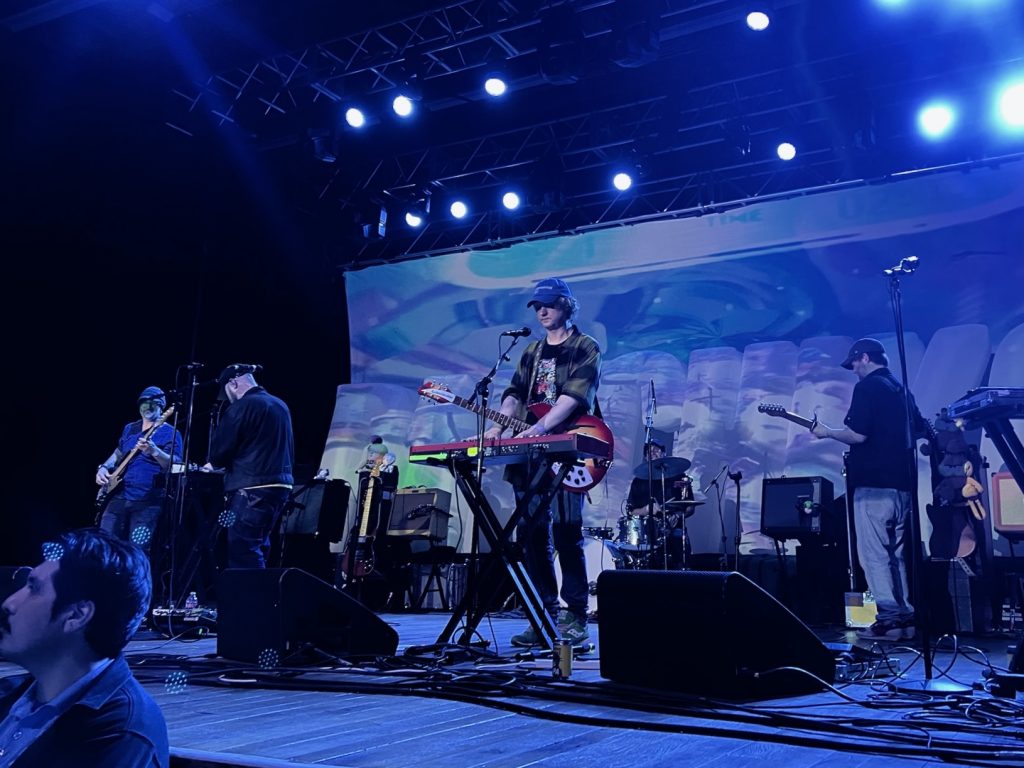
After my friend and I had moshed ourselves to the front during Clarion and Dead Calm’s opening sets, fans began cheering on any sound technician or audio/visual crew member on stage in hopes of luring out our main course. Though there wasn’t music to mosh to, there was still a continuous push towards the front to get the best view of whoever we’d get to see in the next few minutes.
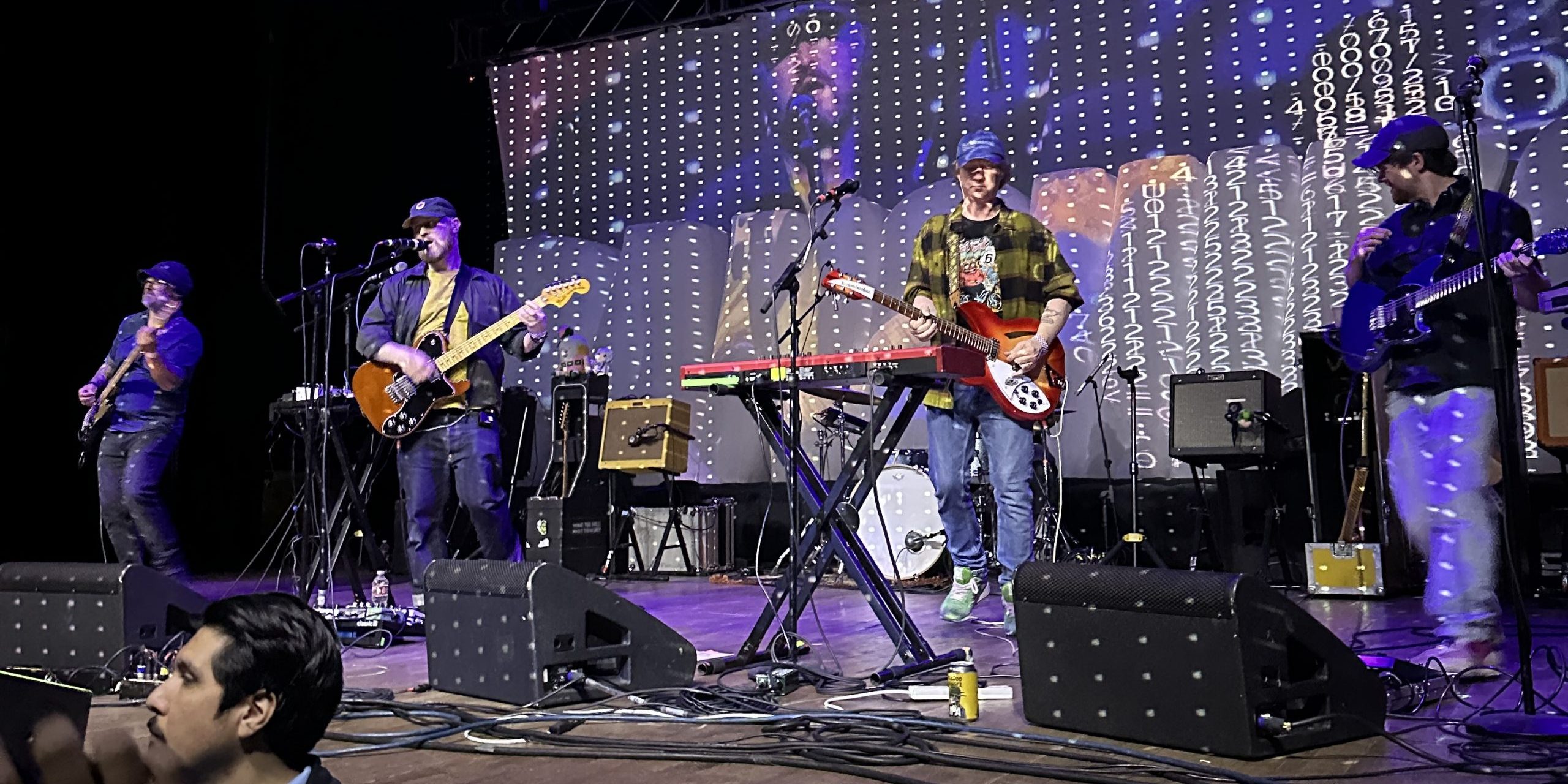
Giant white letters revealing an inflatable “Panchiko” crept up in the foreground while the members emerged on stage. Owain Davies (vocals/guitar), Andrew Wright (guitar/keyboard), Shaun Ferreday (bass), Robert Harris (guitar), and John Schofield (drums) opened with “Stabilisers For Big Boys.” Whatever space we had managed to carve out for ourselves in the barricade immediately disappeared again as the crowd surged forward.
His walkie-talkie-esque segment of the song was echoed louder from the crowd, almost in conversation with Davies:
I’ll bathe the angels in blood ’cause it’s that time of the month /
I wanna worship the sun, don’t pull a face when you cum /
You never suffered the truth because you wasted your youth /
I wanna do what I please because they fuck you with ease /
As a D>E>A>T>H>M>E>T>A>L album enthusiast myself, this song’s level of yearning and anger made me quite excited to hear what their newly released music would sound like live. Panchiko’s newer material sits in that space where lyrics are still abrasive, but the delivery and arrangement give them a reflective, warm, playful, and lighter weight.
A lot of that comes through on their 2025 studio album Ginkgo. The record is comparatively restrained in how it moves. Tracks tend to build in a straightforward way, introducing a melodic idea early, letting it repeat, then slowly widening it rather than breaking it apart. Their single “Ginkgo” is a good example of this as it keeps unfolding from small adjustments into a crescendo of yearning, nostalgia, and love. Again, the young crowd (myself included) lives in a constant state of transitioning and self-discovery. At this stage of life — love, loss, friendship, romance, neglect, fear, isolation, and nostalgia all feel so confusing and unidentifiable — experiences that seemed and still are so easy for the members of Panchiko to voice for others.
This same angst and crescendo later found itself in the quintet’s transition to the song “Gwen Everest,” which seems to be about the way people lean on substitutes for dealing with pain. The small reassurances and performances of okay-ness that try to manage pain rather than confront it directly, make up the main chorus, which we all knew from heart:
If you buy that smile /
to run last mile /
or evade to nude your pain /
you said ‘don’t do this for me again /
The rest of the lyrics circle that same idea, where belief, love, or hope aren’t really presented as answers, but as things that shift between helping you get through a moment and quietly falling apart once they’ve done their job. What is internally intended to be melancholic and misanthropic gradually becomes outwardly expressed as euphoric. Mosh pits began to fluctuate, and the crowd surfing commenced. There was no complaint of a rib getting jabbed or a head getting kicked because how could you when Panchiko was playing while it happened?
The group closed with songs in their top five most listened to works of their career. “D>E>A>T>H>M>E>T>A>L,” “Laputa,” “All They Wanted,” and “Kicking Cars,” almost as if they especially wanted to mess with our emotions. Their song, “D>E>A>T>H>M>E>T>A>L” eased into “Laputa,” as both songs tied together emotionally through stories of living in something already distant and faded out, or something static and unchanging. In turn, revealing some tears on faces from the soft light of the sea of iPhone lights and waving arms. In “Kicking Cars,” lines like being “another stupid pet” land less as shock and more as an exhaustion with the roles people are expected to play. Taken together, this final stretch didn’t feel tailored for an emotional resolution but rather a continuation of our internal battles. Each song returned to the same unresolved loop of wanting escape, recognizing constraint, and still imagining something beyond it. And while we might not have an answer for any of it, Panchiko can at least help us feel it.
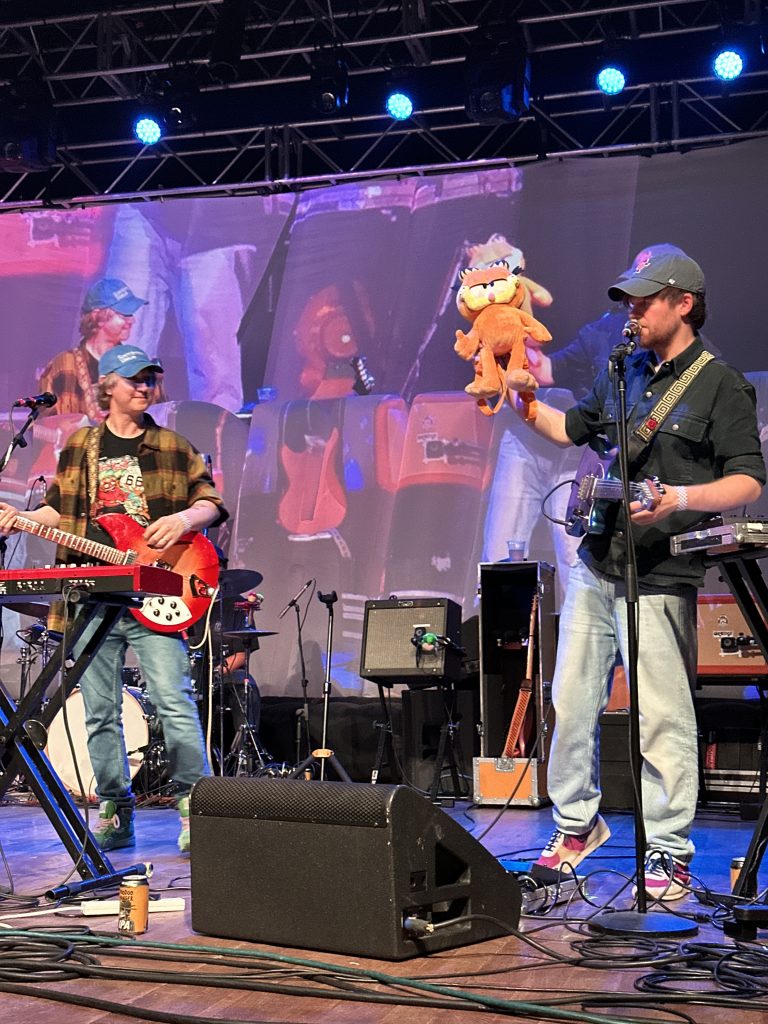
Bubbles were mass-deployed, multiple Garfield bags were thrown, and blood was shed over setlists. Only some survived to tell the tale. This is my #Panchiko story.
Check out Panchiko’s album, Ginkgo!