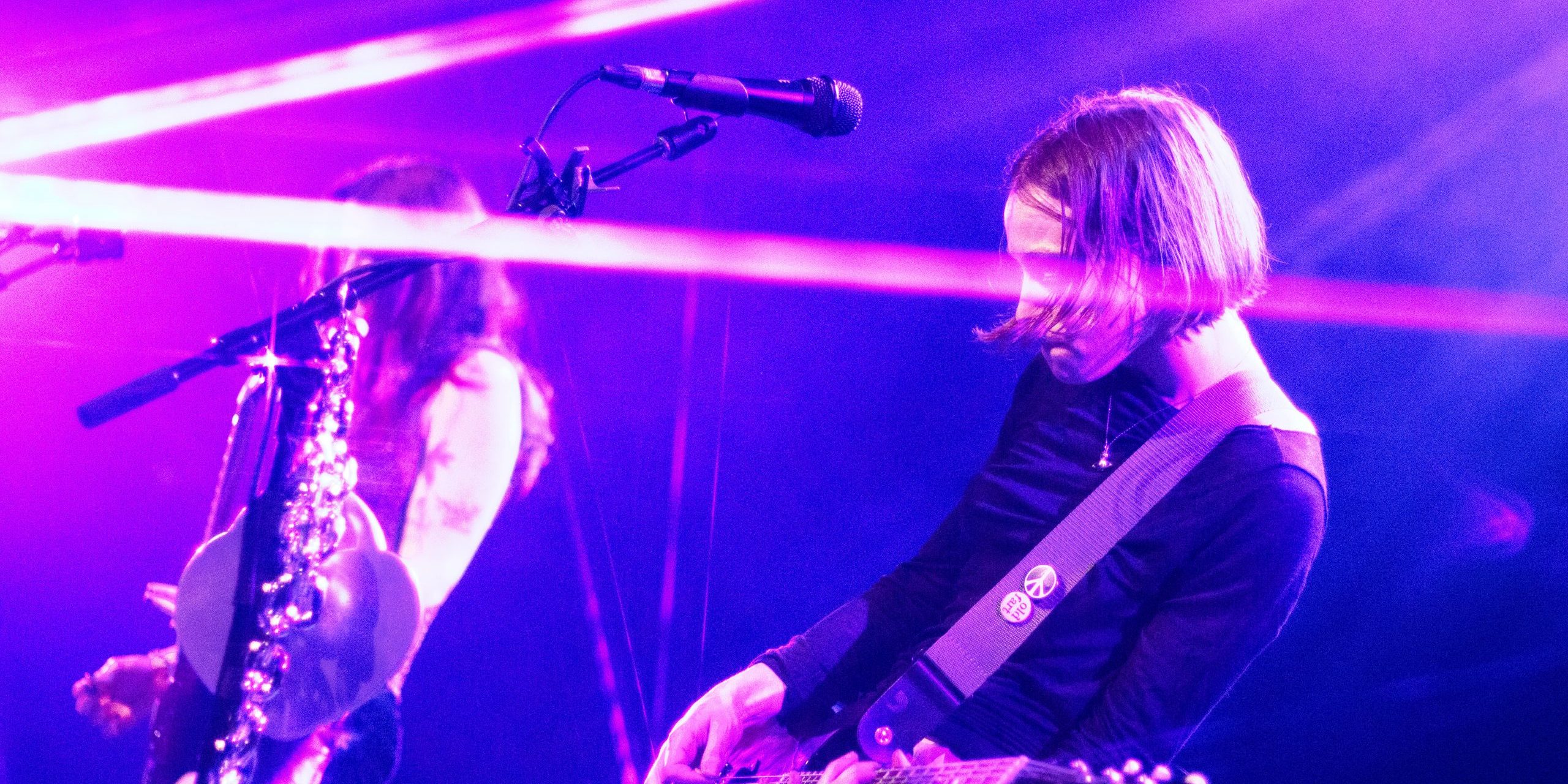
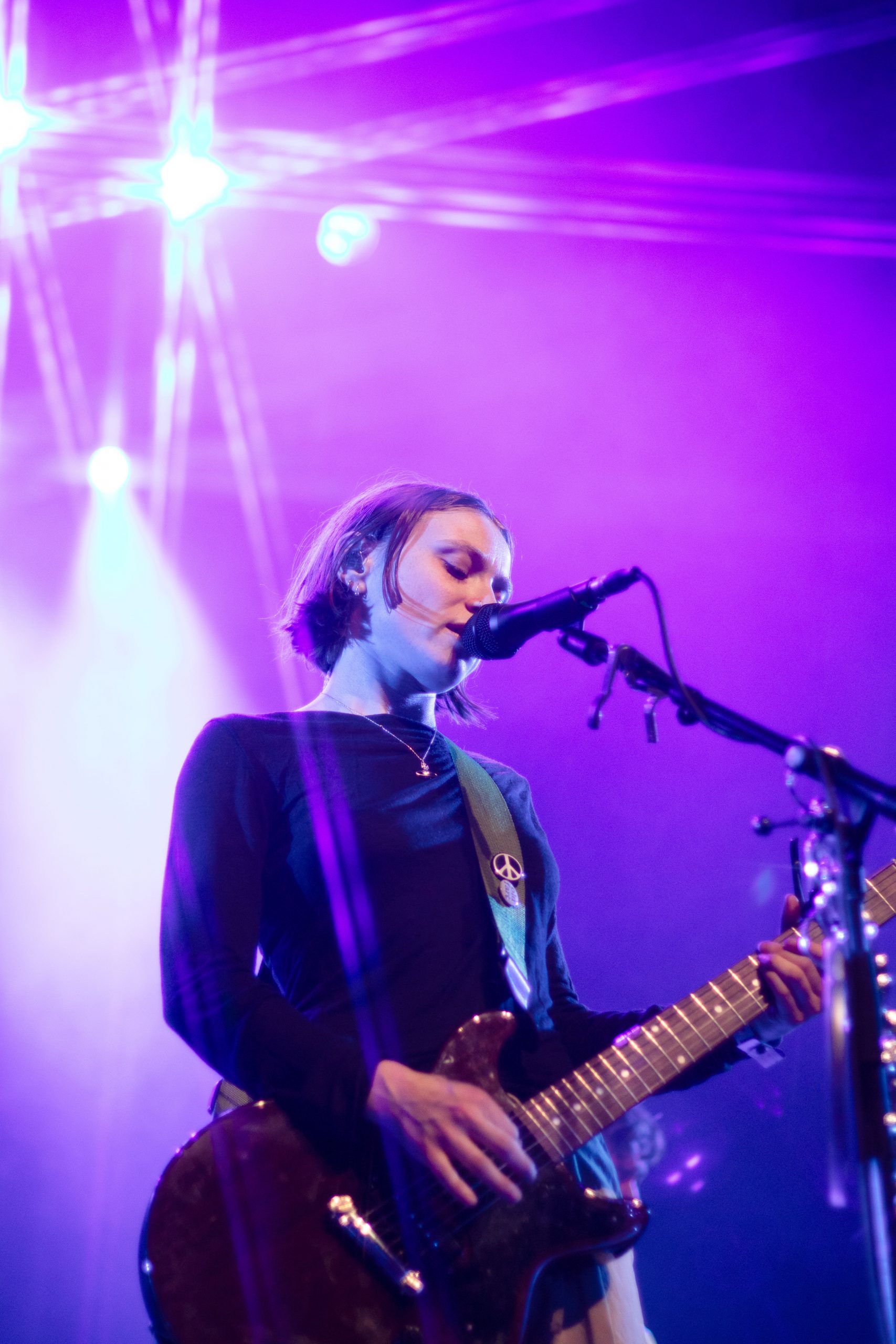
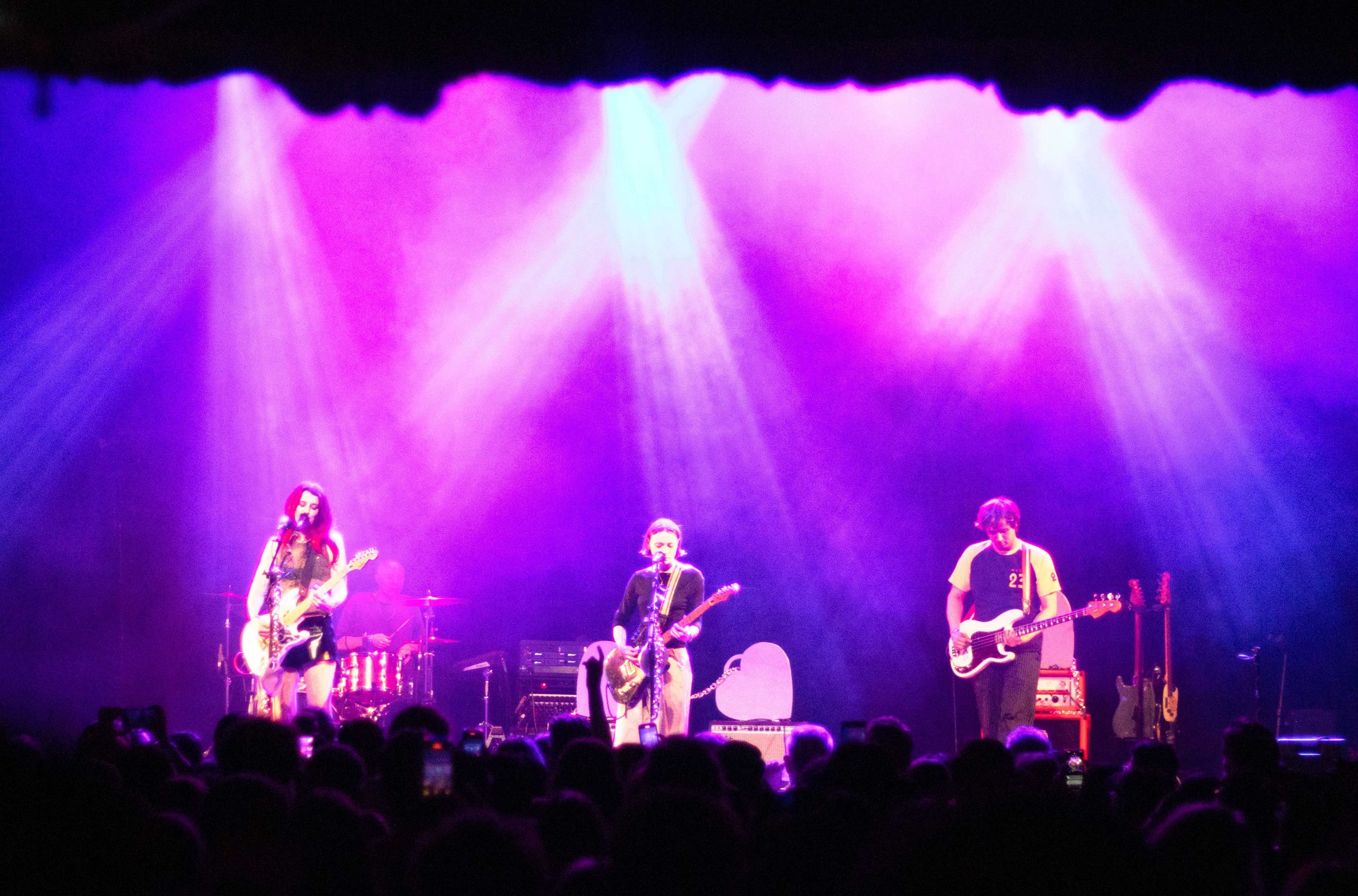
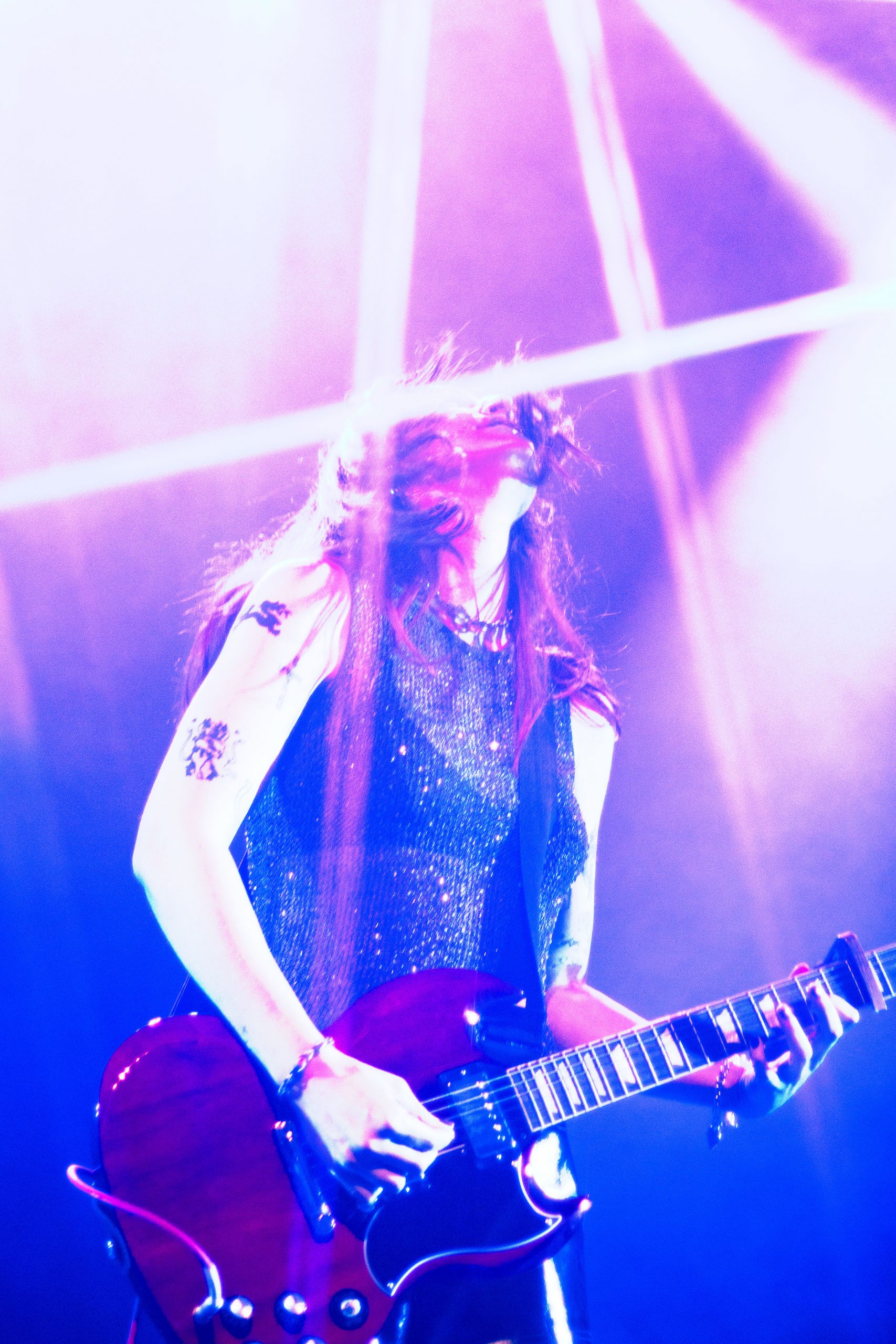
Photos by Dylan Simmons of Momma at the Fonda Theatre (5/9/25).
UCLA Radio’s Rising Artist Spotlight aims to highlight upcoming artists who have demonstrated unique creativity and talent through their music. Through interviews and features, we delve into their journey, influences, and aspirations, giving listeners a glimpse into the future of music.
Momma is Allegra Weingarten (vocals, guitar), Etta Friedman (vocals, guitar), Aron Kobayashi Ritch (bass, production), and Preston Fulks (drums) — a four-piece indie rock band based in New York. Founded upon the central friendship of LA natives Weingarten and Friedman, the band is enjoying a hard-won trajectory toward success.
Over years of experience, tours, and releases, Momma’s anthemic lyricism, catchy guitar riffs, and enduring ambition have driven their steady rise within the contemporary indie rock scene. While early LPs Interloper and Two of Me cemented Momma’s alt rock roots and ‘90s influences as they explored their sound, their two recent albums — 2022’s Household Name and 2025’s Welcome to My Blue Sky — are distinctly Momma. These records earned them widespread critical success, interweaving electronic and pop elements with Kobayashi Ritch’s production, while still paying homage to hallmarks of ‘90s alternative.
Existing in the pervasively male-dominated scene of alt rock, Momma has helped champion queer and femme people in such spaces, both onstage and in the audience. Their various influences and timeless appeal result in a diverse live crowd, where teenaged lesbians share the barricade with middle-aged dads. In a now-infamous Instagram livestream, they commented on this dynamic: “If you’re an old white man, don’t stand front row when there’s young girls behind you.” Despite some lingering backlash, their statement still garnered support from those uplifting marginalized people in alt rock spaces, and further fueled the band’s advocacy.
The grind still doesn’t stop for Momma. After releasing an album (and a stellar deluxe edition) in 2025, 2026 is full of tours and festivals, and 2027 will likely find the friends producing their next record, which is just beginning to take shape.
As a long-time fan of Momma, I was eager to chat with the band at this precipice in their career, reflecting on the iconic releases and hard work that got them this far, and aspiring for further milestones to come.
–
Interviewed by Dylan Simmons on August 5, 2026. This interview has been edited for clarity & brevity.
Dylan Simmons: You guys are on a crazy run of festivals and touring right now, and you just made your Lollapalooza debut. How’d that go?
Etta Friedman: That was awesome. It was super fun and really exciting and cool.
Allegra Weingarten: We almost got rained out for a second, but then we didn’t, so I think we’re all just grateful that we got to play.
Etta: 100%.
Dylan: How was the crowd like in the rain and everything?
Allegra: It was good. There [were] more people than I expected. I’m so bad at looking out into a crowd and having any idea of how many people are there. It definitely didn’t feel empty, which is good.
—
Dylan: Your guys’ friendship is very core to what Momma is. The way that the band has evolved over many years, with constant touring and festivals, moving from LA to New York, and opening yourselves up to a lot of public attention on your recent LPs — how do you feel like your friendship shapes your professional relationship, and how does that kind of support help you through these potential stressors?
Etta: That’s a great question. The first thing that comes to my mind is we already just have an insane amount of trust with each other. So, in regards to going through a business with your friend, I feel like that [can be] really difficult. I trust Allegra a lot. There’s also a lot of things that she’s really good at that I would maybe be lacking in. In so many different aspects, we’re able to help complete each other, so I think that’s what helps create any type of success or [mutual] understanding.
Allegra: I think it also extends to Aron and Preston, who also play in our band, and everyone that we’ve hired to come on tour and do sound or TM for us. We really prioritize a familial environment, and I just feel like we know so many people in bands that just hire [randoms], and then you’re just in a band with random people. It’s just really grounding that no matter the situation, we’re all so close that any kind of annoying thing that could happen is just gonna end up being a funny story.
Etta: Absolutely, yeah. That hired gun thing totally works for other people; it’s just what we prioritize in our touring party. And I’m happy that all of us are pretty aligned on that.
Dylan: Yeah, that’s so great. I know touring can be so stressful and wear on you so much. So doing that, even with just a slight disconnect between the people involved, feels like that would just compound so easily.
Allegra: I can’t imagine, yeah.
—
Dylan: Thinking about Household Name and Welcome to My Blue Sky– I feel like these records have definitely shot up the amount of attention and critical reception you guys have gotten, which is really cool to see, because I’ve been like a fan since like 2021, so I’ve kind of seen that jump. With how insane touring and festivals have been, and just how big these last couple albums have been, how does that feel for you guys?
Allegra: I’m very proud of where we’ve gotten, and every single moment is not lost on me. Playing Lollapalooza is such a surreal moment, and we all went to dinner two nights after, and we were like, we’re all proud of each other and proud of ourselves. We’re definitely taking it all in, and very grateful. But I feel like we’re on this very exciting precipice where we’re doing really well, and there’s huge promise and potential and stability that we can see, but there’s just a couple more milestones to reach before we get there. A lot of people that don’t play in bands don’t understand how expensive it is to tour and stuff, so like we’re kind of still at that gray area where we’re doing these huge things, like Lollapalooza is crazy, but we’re losing money to go and do it. And we’ll do it any day of the week, but like–
Etta: It’s hard.
Allegra: We saw Turnstile live at Lollapalooza, and like, that’s an inspiration, and we can’t wait until we get to that point. And I think we will.
Etta: Totally. I think the biggest lesson is just how to build up longevity, and just witnessing how other people go about things is really interesting. But I mean, to be honest with you, even someone being like, “You guys are doing really well” — that doesn’t feel right. I think it’s really hard to not compare yourself, and there’s always going to be a higher rung of the ladder that you want to reach. I think everyone in the Momma camp [are] pretty determined and driven people. We just have these big goals, but I think my biggest thing is just you have to bet on yourself, and betting on yourself is really, really difficult. Also, we’ve met bands where some people are like, “I don’t even know if I can do that”; like, “It’s not feasible financially for me to do that.” So we’ve just been lucky enough to somehow have timings work out or just plan out our lives a bit where we’ve been able to bet on ourselves, and it’s been doing OK. To Allegra’s point, we are so grateful, and none of the cool experiences are like lost on us. Literally, also at Turnstile, we turned to each other, and we were like, “Our life is dope. This is so cool.”
Dylan: That makes a lot of sense. Obviously you guys are on this awesome upward trajectory, but there’s definitely still more to come. And I think that having that aspiration and that drive to keep going and keep chasing those higher benchmarks is so important to get through the strain of touring right now, in this economy, at the state that you guys are at.
Thinking about that trajectory, what comes next for you guys? Are there any projects coming up? Are you eager to get home and write, or do you just want to keep touring?
Allegra: We’re definitely gonna transition into a writing phase. We’ve already kind of started, and I think our mindset with that ties into what we were just talking about, like not getting too comfortable and always wanting to level up in some way. So we talk a lot about how we need to bet on ourselves and maybe try something different that feels us and that feels super purposeful, but also feels like only we could write these songs or make this record, and that’ll probably take a little while to figure out what that is, but we’re all excited to see where that goes.
Dylan: What kind of influences and genres are you pulling for this upcoming music?
Etta: We’re pulling from some really random things, honestly. But also, the main switch up in my head is like just a different process of how we’re going about things. It’s a lot more fluid than how we usually do.
Allegra: I mean, I don’t know about specific inspirations, just because honestly, I feel like we’re trying to steer away from that. I don’t want to keep being compared to another band that has already existed, you know? But Household Name and Blue Sky I feel like had these breezy, summer, driving with the windows down vibe, and I feel like this album’s gonna end up being a little darker, more like fall, rainy day vibes. And we’re trying really hard lyrically to push ourselves and put people in one very zoomed-in, weird situation and then talk about that in a nonliteral way. The last record was pretty literal.
Etta: Yeah. How I’m thinking about this is like, if you listen to really old Momma, we were teenagers and really trying to explore just who we were as people, and what it is to be in a band and make songs with your friend, and we’re so inspired by these really weird things and getting hyperfocused on that. Then we hit this period [where] we don’t need to be thinking that hard about things, and we can do things a bit more literally, and make a different sound. We’ve learned a lot from both of those [periods], and it feels like that’s what we’re taking into this next [record]. If anything, if there’s any inspirations, it’s more like [specific] sounds than it is one band in one genre. I think Allegra said it perfectly, where we’re not really trying to fit into a thing right now.
Dylan: Yeah, that makes sense, and I get how that can be very reductive. Now you’re just like, “This is Momma” — you’ve definitely found yourselves, and you’re leaning into that distinct sound.
How does the writing process look for you two? Where do each of you find inspiration or snippets of songs, and then how do you guys bring that together?
Allegra: I think Etta does the same thing– I have a Notes folder in my phone, and a lot of the phrases or words that are written down in there are just things I overhear, like if I’m watching a video or if I just hear someone on the subway say something cool. Then we’ll sit down and write a song, and we’ll each go through our little catalog of things that we have, and then I’ll be like, “Is this word weird?” And I’ll try to work it in, and then Etta will be like, “Oh well, I actually had this word written down, which maybe makes more sense.” I feel like we start with the word or the phrase, and then assign meaning to that, as opposed to being like, “We have this feeling that we want to talk about. How do we say it?”
Etta: This time around has been funny because, at least for me personally, coming out of a record that was so personal and so literal, it was so easy to just tap [that] well. Like, I know exactly what feeling I’m trying to relay and what we want to talk about. This time around, I’ve been trying to read stuff and kind of glean phrases from that. For example, I was reading 69 Love Songs (33 ⅓), and for whatever reason, they have a whole dictionary at the beginning of it of just random things. So that was fun to look through, because like you’re making up words, or like I wouldn’t have paired these two things together. And then also, I write down things that I mishear, like misheard lyrics, a lot. Because sometimes I’m like, “Whoa, that’s such a cool line,” and then I look it up and I’m like, “Oh, they did not say that.”
Dylan: Yeah, that makes sense. I’m sure you’ve been asked a lot about the writing in Welcome to My Blue Sky, because obviously it’s a very unique record — like you said, it is very literal, very vulnerable, very open. How did that feel to get all that written down, and expose that to the world, and be ready to take in whatever reactions people had, or reception to that?
Allegra: It was definitely a little scary. Now, when I listen back to the record, it probably didn’t seem as confessional as it felt at the time. Only because all of these songs that we were writing about infidelity and wanting to break up with our partners was a completely unknown thing to our partner, and to us. So it just felt like we were writing it and working it out in real time. By the time the record came out, my ex didn’t even know that I was thinking those things, so it definitely felt like there was a lot on the line. But also it’s a pop record; these are three-and-a-half minute pop songs, and there’s only so much you can say. Also, we’re a little put off by lyrics that are so hyperspecific to our experience, like dates and times and names and places. It’s this style that’s become really popular now, and I just think it’s kind of boring.
Etta: It’s so boring.
Allegra: We really prioritize how things sound being sung, and you keep in mind people singing the lyrics back to you as well. It’s like, we’re not gonna try to fit this entire soliloquy in a pre-chorus, because at the end of the day it’s owowowowow.
Dylan: [Laughs] Yeah, exactly. You want it to resonate. Obviously you’re writing for yourselves, but I think you guys are really good at capturing a specific feeling where it’s like, maybe I haven’t cheated on somebody, but I know this feeling of sneaking around and feeling infatuated, or just very universal human emotions that will resonate with a lot of people, and the experiences of life that we can all connect with.
Etta: Totally. And I do think that was at the top of our minds while writing something so personal. Like, it is a really specific situation, so how can someone listen to this and relate to it? Not just think like, “Oh, I bet that was crazy for them.” [laughs]
Dylan: Now that this record’s been out for a year and some months, now that it’s sat with people, how do you guys feel about that? How do you feel about how people have connected to those themes?
Allegra: Hmm, yeah. Good. I feel like every single time you play a show, a new life is breathed into every song, just depending on who you’re making eye contact with at that very moment. That’s why it’s so important — if you’re gonna be front row at any show — please be present with the artist, don’t just stare and be boring. It means so much to us to see people up there, especially young femme and queer people, to sing the words back to us like that. I’ll literally walk away being like “Oh my God, ‘Brave’ is my new favorite song now,” because there’s just one girl crying, singing every single word, and that means so much to us. So that’s a really big part of it. Like, I see people singing “[Welcome to My] Blue Sky” now, which, when we toured the record, I feel like people didn’t really know that one yet. And now I see people sing it, and I’m like, now this song means something to people, and we made the right choice by writing it and putting it on the record.
Etta: Absolutely. It’s also interesting to see the record have a different kind of life cycle on its own, too. That’s how music can work. Maybe someone listened to the record when it came out and was just like whatever, and maybe months go by, and they have their own experience separately, and refind the record. I just think connection is really important to us. Also to the point of being an audience member, I hope that we can cultivate an environment where no one’s too cool, you know? It’s way more fun for everybody, and especially for us. Like, you’re at a show; you’re there for the experience. Think about all the other people that are there because you guys share a common interest. I think that’s so lost on us now. I think everyone’s a little too reserved. Growing up in LA, how I made my closest friends was going to shows and being shy, but being like, “Oh, cool, we both like this band” or “I see you now every week because we’re both going to the same venue.”
Allegra: Not to be a total boomer, and I don’t know when I first started going to shows — like 2012, 2013 — Instagram didn’t have stories. Snapchat didn’t exist. So I wasn’t going to the show to post it and show people that I was there. I literally was going to be front row and walk away with my knees bruised because I was having so much fun. And we try to reward that behavior, too.
Dylan: Yeah. I think we’re in a nonchalance epidemic, and I’m like, let’s start getting vulnerable guys. Let’s talk about our feelings. Let’s have fun. God forbid.
Etta: Yeah, don’t be embarrassed. I mean, it’s really easy to get embarrassed. I get it; I’m the same way. But if you can let go of that a little bit and just be like “Whatever, I’m just doing my thing,” you’re gonna have so much more fun in life.
Dylan: Totally. Authenticity is cool.
—
Dylan: I saw someone say, talking about Welcome to My Blue Sky, how this album was the first time you wrote about a sapphic relationship explicitly. I didn’t know if that was actually true, but it definitely was talked about very openly. I think especially in alt rock and indie rock spaces, it’s still hard to find a lot of queer and sapphic representation explicitly in songwriting. So Etta writing openly about that and living publicly in a queer relationship — how does that feel connecting with your fans in that kind of way? Like, inadvertently being that kind of representation, even if that’s not the point of you just writing about your life.
Etta: It’s been really rewarding, playing that song [“How to Breathe”] and seeing girls immediately hug each other. I think that’s really cool and cute, and it’s nice to be able to create a space where people are feeling safe doing that, especially in random cities or countries. I think that’s really cool. It just feels rewarding, because writing that song, a lot of that was just like, I wasn’t fully out to my family yet. A lot of my relationship has helped me actually step into myself and feel comfortable with myself. So I think that song is kind of a representation of feeling OK being who you are, as cheesy as that sounds. For me, it just felt cathartic to write, and it felt necessary.
Dylan: That’s awesome to see that it’s been an important process for you and it’s helped you, but it’s also helping others and connecting with others. Just to add onto that very personally, my first date with my ex-girlfriend was at that Greer concert [where Momma opened], so that was big. And even before this new record, I feel like there were a lot of Momma songs that resonated with us a lot, or that was part of our relationship to each other. It’s cool to see that this band that I felt connected to, or like has resonated with certain parts of my relationships, it’s cool to see talking even more openly about being queer, and to see other people connect to that as well.
Etta: That means a lot, thank you. That’s really cool to hear. I’m so happy that that’s your experience.
Dylan: Yeah, and I’m sure you guys can relate to that feeling of sharing music being very personal and vulnerable. But I really love that, and I love the idea that that’s bringing even more people together, especially queer women, and especially in a space where indie and alt rock has always been (and still is) very straight-white-male-dominated. So it’s cool to see.
Allegra: It’s coming back.
Etta: It’s coming back!
Dylan: I know. It’s crazy. I love female-fronted rock — not to put it in its own category, obviously, because it’s just rock — but it’s just such a good sound, and I feel like most of my favorite artists fall into that demographic. And like, yeah, it’s tired. You guys talked about it before, like the middle-aged men at concerts where the leads are young, attractive non-men: you guys, Wet Leg, Die Spitz, I feel like have faced a lot of that kind of male attention. I think it’s also just cool– Again, you living your life is not trying to be representation, but it’s cool that it is still providing representation and it is still creating more of these spaces for not white guys, you know?
Allegra: Totally. We still get comments to this day that are like, “Well, I’m a 40-year-old man, so I guess I’m not allowed to come to your show.” Which is just like, if you’re literally gonna be like that, then don’t. But on the other hand, if you’re gonna come and be respectful and love the music, then obviously, please! We welcome any and all people. But just know that if you’re a 45-year-old straight dude and you’re standing front row, like two or three rows behind you there’s a lesbian couple holding their hands that can’t see over you, trying to look at Etta singing “How to Breathe.” Like please, know your space, and know where you fit into every dynamic.
Etta: Totally. Also, I was thinking about this because you said Wet Leg– When we went on tour with them, there was a whole thing about how you [can’t] take a picture of your laminate. And I remember being like, “I’m curious, why?” And they were just like, “There are these men who have been copying what the laminate looks like to try to get backstage.” And I was like, “Oh my God.” Like, that is actually psychotic, and just really nasty and weird.
Dylan: I don’t understand. Men just love to be in spaces where they do not need to be. Like, know your place. Be respectful. Treat people like people, you know?
Allegra: We have one fan who’s a middle-aged man, and we know him by first name. We love him to death. He’s barricade at every single show he comes to, but he brings the fucking energy. He’s not on his phone, he knows every single word, he’s rocking out, he’s connecting with the girls next to him– He is amazing. He’s welcome anytime. Anyone that just wants to come and have a good time, like, please. It’s the line of straight-faced men who are just staring that freak us out, and it’s super fucking weird. And it should not be controversial to say “Please don’t take up that space.” Did we forget Bikini Kill, “Girls to the front”? There are people that connect to this shit on their own level and a deeper level. Just be cautious and aware.
Etta: Also, mad respect to Steve, this guy, because he definitely has been with us since before we even said that thing, and he’s been hella respectful. At least for what we can see from the stage, he’s been great about it.
Dylan: That’s awesome. Exactly. The people who are pissed off about what you said are obviously missing the entire point completely, and maybe are just trying to ragebait, and maybe they weren’t gonna go to your show anyway, because they’re being a fucking loser.
Etta: And that’s actually just the truth right there.
Dylan: It’s so dumb. But yeah, all that to say, my dad also loves you guys. I put him on, and he loves your music.
Allegra: We also make the exception, because I used to be the 12-year-old girl that wanted to go see shows, and my dad would come with me. We can see when it’s a dad, he doesn’t know the song, whatever — but he’s standing behind his daughter, who’s stoked. Like, that is totally fine. It’s a very specific breed of person that we’re talking about.
Etta: It’s really easy to spot them, too. They’re not slick.
Dylan: Yeah [laughs]. No, definitely. It’s so easy to tell when a guy is being creepy. I think it kind of becomes an instinct, unfortunately. Obviously you’re not trying to isolate this whole demographic; it’s literally just like, don’t be a creep. And if you’re getting pissed off because I said “Don’t be a creep,” then obviously you’re a creep. Because normal people would respond normally to this. It’s not that crazy.
—
Dylan: I’ll wrap up with this LA show that you guys are about to play. You guys are from LA, and I know you’re friends with Rocket, so that’s just an exciting show, exciting lineup. How are you feeling about coming back and doing a little hometown show?
Allegra: Excited!
Etta: I’m excited. It’s always kind of nerve-wracking doing that for some reason. I don’t know if it’s because our families are there, or because it’s [our] hometown, and you just want to show out and make sure you do a really good job. But I’m so happy that Rocket will be playing with us. They’re so good and so fun, and it feels like a really good match. We’ve been wanting to play with them for a while, so I’m really excited about that. And Dan English will also be playing, so New York, represent. We got kind of a well-rounded vibe.
Dylan: That’s awesome! Yeah, Rocket rocks. That’ll be such a good lineup.
—
Listen to Welcome to My Blue Sky (Deluxe Edition) by Momma!
Discover Momma and more on our Rising Artist Spotlight playlist!