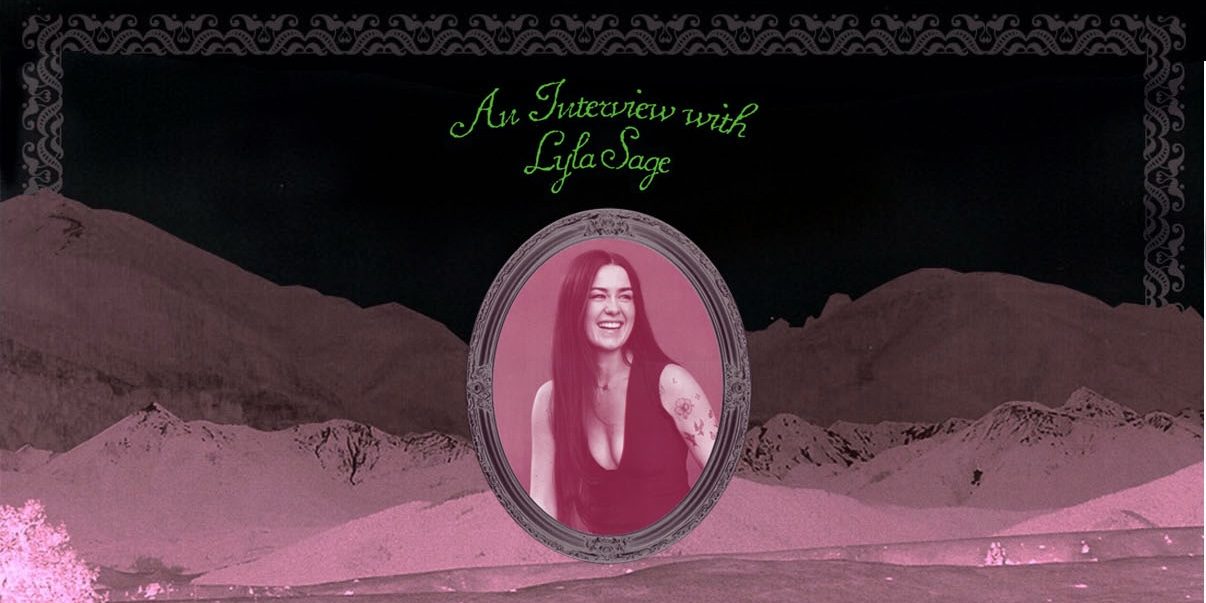
New York Times bestselling author Lyla Sage imbues her stories with her favorite things: sunshine and big blue skies. Through the release of her Sweetwater Peak series, she’s adding ghost stories, antiques, and the people and things that hold up rural communities to that list. Her books are atmospheric; her stories radiate the kind of hope and humanity we all fundamentally need. I’ve been a devoted reader of hers since the summer her debut novel, Done and Dusted, showed me that a life filled with “love, support [and], purpose” (Sage, Done and Dusted) was not only possible but achievable.
I had the absolute joy of talking with Sage for my show Swan on the Roof about her newest release, Free Falling, the second and final installment of the Sweetwater Peak series, reflecting on music, rural communities, honesty in writing, and the aching, beautiful, multifaceted nature of being human.
Interviewed by Olivia Aerin Lee on September 25, 2026. This interview has been edited for clarity & brevity.
Olivia Aerin: Hi Lyla! Welcome to Swan on the Roof; it’s so exciting to have you on!
Lyla Sage: Thank you so much for having me, Olivia. I really appreciate it. I’m so happy to be here.
OA: Yay! First of all, congratulations on the release of Free Falling! Publishing week, woohoo!
LS: I know! Thank you; it’s been out for four days at this point. Feels like a lifetime, feels like four hours. I really can’t decide where I fall on the spectrum.
LS: This is my stop at home on my book tour. It’s been incredibly chaotic. I haven’t known what time zone I’ve been in for the past four days, but I’m back in Mountain Time! Get me to god’s country! Just kidding.
OA: [laughs]
LS: Mountain Time!
OA: I’m so glad you’re having a moment of rest! I’m grateful that you’re here.
OA: I’m practically bursting with questions, so if you don’t mind we’ll get straight into it!
LS: Yeah!
OA: Since we’re here at the radio, I was hoping to start off with a music related question.
LS: Sure! I love.
OA: Amazing. You’ve created some incredible Spotify playlists dedicated to your books and Amos Ryder, love him. Personally, I’ve loved turning on your playlists when I miss a particular story or world of yours. I’m quite literally still at the restaurant, I’m always at Chili’s, with Cam and Tucker, so I frequent Wild and Wrangled’s playlist often.
LS: That’s a great one.
OA: When you start writing a new book like Free Falling or your mysterious angsty 2027 release, do you find the music first to set the vibes, or do you discover the music as you write the story?
LS: Both! I think music plays a huge role in my process, which is really lovely and really special. I try to get a couple of songs going on a playlist to get the vibe, and that’s kind of the only work I do that requires something besides my own brain beforehand. I don’t make a Pinterest board or do something like that. I do all of my character work analog in a notebook.
OA: Wow!
LS: My playlist is the only thing, because if I made a Pinterest board, I’d be making Pinterest boards for like a month and a half, and I wouldn’t write a single word!
OA: [laughs] The rabbit hole.
LS: Right; the only thing I allow myself is the playlist, so I take it very seriously. I get a few songs, and then, when I write, I see the book like a movie in the front of my head. What ends up happening is that I end up scoring the book the way someone would score a movie, and those are the things that you see on the playlist.
OA: That’s incredible. Do you start with a certain genre? Or do the songs naturally come to you as you’re coming up with the book?
LS: Yeah! It usually just comes to me. I’ve got a rich music knowledge in old-school country, a lot of oldies, and like, 80s new wave and 90s grunge is where my knowledge base lies, so I think it kind of starts with stuff like that.
OA: A holy trinity.
LS: Then it will move differently or shift, or I might hear something, a song I don’t remember, and it will move and shift with it, but the basis is always oldies in some capacity.
OA: Love! No better foundation than that. Speaking of Sweetwater Peak, it’s so exciting to return there with Clarke and Leith, especially knowing this series is rooted in your love of spooky stories and the Wild West. Without giving too much away, what can we expect to see in Free Falling?
LS: I mean, I think the opening of Free Falling is pretty epic. The whole situation starts because [our main character] Clarke’s childhood crush’s dead dad just won’t leave her alone, ‘cause she talks to ghosts.
OA: [laughs]
LS: And I think that’s a wonderful start to a novel.
OA: What a way to start.
LS: Right? I think both Clarke and Leith are incredibly complicated characters who are both experiencing really rough times, and because of that, the thing that was most important to me was making sure that we could be, because Clarke is also depressed in the book, but you can be depressed and still be hot and fun.
OA: Amen!
LS: Right! And the hottest and funnest romance trope to me is fake dating. So I wanted there to be a fun juxtaposition between the realities these two are facing, and I just wanted them to have a chance to have a lot of fun.
OA: Absolutely. There was such a vulnerability between them, I think, that that fake dating provided them space for. And like you said, you can be sad and still be hot and fun, and I think the book captured that beautifully.
OA: Your books are both character driven and exceptionally atmospheric. Plotting a story is one thing, but seeing how characters actively inhabit a space often reveals unexpected surprises. While building Clarke and Leith’s dynamic, was there anything, either narratively or emotionally, that emerged during the writing process that surprised you?
LS: I think the thing, narratively, that was not something I did intentionally, but something that became the core of the story, is that both Clarke and Leith are trying to save their family legacies. For Clarke, that’s Toade’s Antiques, and for Leith, that’s Wilkes Farm.
LS: The state of both of those things were reflective of the mindset of each of these characters. Toade’s is kind of falling apart; it’s dilapidated. It needs some tender love and care. And for the farm, it’s something that everybody in Sweetwater Peak depends on, and that’s Leith’s struggle. He feels he is the center of his family and that they need him to survive, and so does everybody else.
LS: I think that parallel line that runs between Clarke and Leith, and their respective things that they love, was a really special theme to emerge, and after I realized it in the first draft, it’s something that I really tried to handle with care and was really excited about.
OA: What struck me while reading Soul Searching, which was the incredible prequel to this book, was the way Collins cares for the stories embedded within people and places. Kind of like what we were talking about, there is a parallel between Collins and her atmosphere. There is a tenderness in how she holds the lingering stories that get left behind, honoring both the people and the places she encounters.
OA: You’ve shared that your favorite thing about romance is that it prioritizes radical hope. Through the process of writing paranormal romance, was there anything about human nature that the haunting, metaphysical elements of Soul Searching and Free Falling revealed to you that a classic contemporary setting might not have uncovered?
LS: Yes! I think that— that’s a great question, by the way.
OA: Thank you!
LS: There’s a scene in Free Falling in an abandoned carwash, and there is a specific realization that Clarke has in that moment that if humanity is allowed to let something go, they will. And she feels like she is consistently clawing at things, trying to keep them close to her, trying to keep them safe.
LS: That was, I think, a big realization for Clarke’s character. But also, I think there’s a lot of what I am seeing, especially in Western America; like our lands are consistently under attack from the Trump administration. And there are so many of us that are standing at the front lines like, “No, you can’t do this,” but we’re just getting firehosed with terrible news every day that it’s hard to know where to focus your energy and where to fight. I think that entire scene in the carwash was also me processing what is happening to the world around me.
OA: That scene was one of my favorite scenes in the book. There is that moment of vulnerability… It’s hard to have moments of deep self-reflection and realization when the noises are so loud inside of your head. Like you said, when you’re trying to juggle all these things at once and keep them together, that’s something that I found so profound in this book. All the emotional points that you hit in this book felt transcendent. Though I haven’t experienced the exact things Clarke is experiencing, I felt like… is this play about me [laughs].
LS: Yeah!
OA: It reminded me of the universality of human nature.
LS: That’s the great thing about books, right? Feelings that we think are just our own, we read a book and we realize that those feelings belong to others, and when it belongs to others, maybe it’s more real and less scary. Or maybe it’s more impactful, or whatever it is. I fear that’s the point.
OA: Yes! And it comes around beautifully to hope, and again, how in that low moment of hers there is always hope.
OA: In your conversation with Tyler McCall for Voted Most Talkative you shared that creating Sweetwater Peak allowed the truest version of yourself to make it onto the page. As you wrote the second and final installment of this duology, how did your experience of the creative process, and your own self-discovery within it, change?
LS: I just had the best time in Sweetwater Peak. With Meadowlark and Rebel Blue Ranch, four books is a lot of time to spend in one place, and I loved them. Rebel Blue Ranch is so dear to me, but by the time Wild and Wrangled rolled around and I had finished it, and it was time to go, I was pretty ready to go. I was like, “Alright!”
LS: I think the way Emmy feels about Meadowlark in Done and Dusted was kind of the way I was feeling about Meadowlark at the end of the series. I love it so much, but I wasn’t prepared to spend more time there, and I was ready to spread my wings, you know, leave home.
LS: With Sweetwater Peak, the feeling couldn’t be more different. I’m incredibly sad to go, incredibly sad. Every time I get this question, I’m fighting back tears because I love this place. And I think that might have to do with the fact that it’s where I went when Rebel Blue no longer really felt safe to me. There were so many people there, so many people there with very loud opinions. Rebel Blue is bigger than me now, which is a really beautiful gift to have.
LS: Sweetwater Peak is something that I created that still feels like mine, and that makes me incredibly proud of it and incredibly fond of it in a different way than Meadowlark and Rebel Blue. Because all things can be true.
OA: Absolutely.
LS: I say this and some people are like, “Oh, she hates Rebel Blue Ranch.” No, I love Rebel Blue Ranch.
OA: Nobody can hate Rebel Blue Ranch!
LS: Nobody! Rebel Blue Ranch is my hometown!
OA: That’s my house!
LS: That’s where I grew up, like!
LS: It’s so important to me. But it is really special, as a writer, to see how things can mean different things to me at different times. And how much capacity I have for loving my creations in different ways. It’s pretty rewarding.
OA: It just feels like there’s a real vulnerability and an honesty that exists between you and Sweetwater Peak. You’ve previously shared that your favorite thing about Free Falling is that it feels honest. I was hoping you could talk a little more about this idea of honesty in writing. What does it look like for you, and were there characters or moments in Free Falling that demanded they be told on their own terms?
LS: Yes. The very first draft of Free Falling was a draft that didn’t even make it to my editor. I threw it in the trash. Like, I dragged and dropped the document into the trash and said, “Well! Trash! That’s what you are!”
OA: [laughs]
LS: And then I started again!
LS: I really don’t recommend that, if you can avoid it. Jesus Christ!
OA: [laughs]
LS: I think about that, and I’m like, “You big dumb idiot,” but it needed to happen. It needed to happen.
LS: I remember when I turned in the second version of the first draft that actually made it to my editor; she responded back and was like, “Hey girl, I love the book! Here’s what we need to work on. Also, is Clarke depressed?”
LS: And I was like… “I don’t know…”
OA: Is she?
LS: Is she? That’s crazy… because I am! And it was hard because I was writing Free Falling right after Wild and Wrangled came out, which means my dreams were actively becoming true, and I was not feeling good. I was really having a hard time.
LS: So the fact that my blueness, even though I did everything I could to not have that happen, made its way onto the page is a great reminder that writing is incredibly and deeply personal. That’s what makes it special.
LS: And when you avoid these things, part of your story will be missing. So my editor being able to be like, “Hey girl, I think she’s depressed, and I think that’s the part of the story we need to excavate here,” obviously very meaningful and obviously speaks to the incredible editorial relationship I have, but then, knowing that, I was able to treat Clarke and Leith with so much more care because it was explicit and it was in the page. And that rocked.
LS: When I turned that draft in, it was like there was a filter over the story, and deciding to be really honest in this book about what Clarke was feeling and how it was impacting her took that filter away. It allowed me to do my job in the way it needed to be done.
OA: I absolutely felt that care. I think that this was such an impactful and rich reading experience because so many things are held with such tenderness and care, and intentionality.
OA: Just like we were saying, here is someone who is feeling blue, but she is also experiencing her childhood crush, and this person is filling gaps and bringing something new into her life. You can be blue and still have fun; that’s just the human experience. I really appreciated that you didn’t shy away from showing that, and that it wasn’t this glossy “No! She finds him! And it’s great! And they’re in love! And it’s all perfect! He fixes her roof, and it’s fine!”
LS: And everything’s good!
OA: Perfect, hooray! No, there was this acknowledgement of humanity that I felt so presently and intensely. It was beautiful. You don’t need me to tell you, but it was just so beautiful!
LS: But it is pretty nice, so thank you so much.
OA: [laughs]
OA: Speaking of honest people… you’ve mentioned that there have been characters of yours who “mostly annoy” you…
LS: Yeah.
OA: Enter Gus Ryder.
LS: That is correct! Pisses me off!
OA: Which is hilarious. When I first heard you say that I was cackling.
LS: So annoying to me…
OA: [laughs] It must be an interesting experience to write characters that have that sense of autonomy, since as the writer you have total control over the narrative. You could just put him in time out.
LS: So true, so true.
OA: Yet some characters clearly possess a strong enough identity to rebel. How do you navigate writing a character who has a mind of their own?
LS: I mean, you gotta let them have it. You gotta let them have it!
LS: But I think you’ve got to write them a foil, and Gus’ foil is Teddy Anderson because that woman will be humbling him for the rest of time.
OA: As it should be.
LS: There are two women on the planet who are allowed to humble Gus Ryder. And that is me, and that is Teddy. Because he is incredibly beloved. I do often think he is mischaracterized, which is where my annoyance comes from. It doesn’t necessarily come from the purest form of my creation of him, because I love him. And I know him better than anybody else. My love for him is very deep, and it is very sincere.
LS: And I think he is often mischaracterized. And he’s kind of a dick.
OA: [laughs]
LS: So, there are a lot of things playing into this. But he is so beloved by a lot of my readers, which makes me want to be the anti-hero in this situation and be like, “Oh, he’s annoying. And he’s short!”
OA: [laughs] 6’1” by the way, 6’1”.
LS: My short king!
OA: Can I ask how you feel this mischaracterization came to be, and how you feel he’s mischaracterized?
LS: I mean, I feel both him and Teddy are mischaracterized quite often.
OA: I love Teddy. She’s my icon.
LS: Same! My girl, my girl!
LS: I think a lot of this comes from maybe readers looking for specific things, looking at books as sort of a checklist, which I think is wonderful. And I’m not bashing trope marketing in this, because trope marketing is incredibly important and it’s a valuable tool.
LS: But I think people read a character and might have preconceived notions about who that character is because they’ve read a lot of stuff in the same sub-genre, the same genre, so I think Teddy and Gus always get like, “He’s an asshole to everyone but her.” Not true. He’s actually incredibly kind and caring and dutiful. And Teddy, it’s always like, “Oh, it’s grumpy sunshine.” Teddy is not a sunshine; she’s just loud.
OA: [laughs]
LS: There’s a difference! And when we meet her in Lost and Lassoed, when we find her, she’s actually incredibly sad and incredibly angry at the world. I think sometimes when you look at a text, a romance novel, as something that is prescriptive instead of allowing it to subvert your expectations, those expectations… you might end up putting a character in a box when they might not necessarily belong there.
OA: When there’s so much more to their depth. Again, there are so many layers, and really just the humanity, that you allow your characters to be so many different things is something that has resonated with me and has really given me space to embrace all the different aspects of myself.
LS: And Teddy’s angry. I think Ada is angry as well. I think anger is an underlying emotion that exists in many of my women characters. Like I would say Cam; I don’t think Emmy has ever been angry about anything, but Collins is definitely angry too. I think just allowing women to be people is incredibly rewarding.
OA: Absolutely. And it sounds so simple, but the amount of times we’re not allowed to be just people!
LS: Right.
OA: You share some traits with your characters, from Emmy’s dynamic as the youngest child and only daughter, to sharing a music taste with Ada, a love of ghost stories and antiques like Clarke and Collins, and an all around love of tattoos. I imagine that there’s a balance between finding inspiration in your personal experience and giving characters space to have their own unique identities. How do you navigate that boundary? Do you find those personal similarities make protecting their individuality challenging, or does it work as an anchor to create embodied characters?
LS: I think the parts of me that end up in characters are not intentional, really. I think the most intentional was probably Collins and Clarke; I really wanted to talk about antiques, and I wanted a chance to talk about the things that hold up rural communities. Those are things that I’m obviously passionate about that these two allow me to talk about with a safe backdrop where everything in the end gets to be okay.
LS: But writing is just deeply personal. And it doesn’t matter how hard you fight it, parts of yourself are going to make it on the page. That’s why I say it’s mostly unintentional. I generally don’t realize it until I read things back and I go “Oh!”
LS: With the dynamic with Emmy and her brothers, I wanted to write, you know, a biblically accurate sibling experience. So stuff that’s pulled from my life is usually for the purpose of being like, “I want this to read accurately, and I want this to read authentically.”
LS: But there are some things that I don’t realize, because none of my characters escape from me unscathed. They all have something in common with me, whether it’s small or big. Small, like Ada’s music taste, or like I weirdly have a lot in common with Dusty, which I really didn’t realize. I was re-reading Wild and Wrangled a couple weeks ago, and I was like, “Damn!”
OA: There I am!
LS: There I am! It just happens. But it’s never my intention for it to happen, because I’m super uninterested in writing self-insert fiction, but I do want my stories to read authentically.
OA: That honesty.
LS: Yeah. And I also write incredibly voice-y fiction; I write the way that I talk, so my books are incredibly voice-y. I tell stories the way I would orate a story to a friend, basically. Because my voice is so central to my novels, I am on the pages whether I like it or not.
OA: I’ve always thought that was so cool. I know you’ve mentioned before how you write stories the way that you would tell them. I think oral storytelling is so important! We need to bring that back!
LS: Yeah!
OA: So when I heard that, I was like, “That is so brilliant” because it is oral storytelling, but now it’s accessible to people all over!
LS: And it has proper punctuation!
OA: Who doesn’t love that!
LS: All sorts of great things that you don’t get from oral storytelling. I mean, I love folklore. So thinking about my stories as my own set of folklore that I’m creating also is an approach I take sometimes.
OA: That is so beautiful… mythic! Your own set of myths!
LS: Yes!
OA: Talking about antiques, it’s no secret that you have an incredible personal style. You’ve shared how you build your tour wardrobe around an anchor item or a theme. On your Threads, which is an absolute treasure trove, you’ve shared your Free Falling tour outfit wishlist. Can you officially reveal what the chosen item or theme behind your outfits is? Did Clarke’s connection to antiques have any influence on your curation?
LS: It did! It wasn’t necessarily a theme, but I’m so obsessed with the cover of Free Falling. That green that’s on the cover was a specifically picked HEX code by me.
OA: Really!
LS: Yes. I was incredibly particular about it, and there was pushback from several publishers, like my US and foreign pubs. For US, it wasn’t that bad because I really trust my instincts, but there was some pushback on that green, and I was like, “Well, I’m not willing to compromise, so… here we go!” because that green is inspired by Goosebumps. The colors, the way these colors go together, was inspired by Goosebumps novels.
LS: So I think the theme of tour has become Goosebumps color schemes, like me trying to maintain my individuality, which I would say is very much y’allternative, emo cowgirl is kind of the thing I’ve always been and will always be, but adding in some of these colorful elements like a green dress, pink this, green that, has been really, really fun because it also pushes me out of my comfort zone. There was nothing that I wore on the Soul Searching tour that was out of my comfort zone. I was like, “This is great!” because I basically just pulled everything from my closet and was like, “Excellent!” I maybe bought one thing for the Soul Searching tour.
LS: For this, trying something new, doing some clothing rentals, trying to grow and expand in my own personal style was really fun.
OA: Do you think your background in art and design bleeds into your experience with clothing as well?
LS: Absolutely. I mean, I love art; I love to paint. I’m incredibly terrible at pottery, but I still love to do it. And I think it’s good to have a creative hobby that you’re bad at.
OA: Amen.
LS: I think that’s a necessary thing to do if you’re a creative person who wants to take your hobby and create seriously. You also need something that you’re allowed to be bad at and that people aren’t really critiquing you on. So I’m really bad at pottery, but absolutely, I think my background in visual media in general has made such a difference.
LS: And I think before I loved art, and before I loved painting, and before I loved writing, I loved clothes. I loved clothes straight out the womb! Always been a really special part of my identity, and it’s fun to bring that part with me to work. I believe in a good work-life balance; I believe in privacy, but clothes are something that I can bring to work with me that feel like me, and that I can share with my readers and we can bond over it together.
OA: That’s beautiful. Thank you so much for chatting with me today! We’ve made it to the last question.
LS: Amazing.
OA: I thought we could circle back around to one last music question.
LS: Love!
OA: And this ties in beautifully with what you mentioned earlier about the movie in front of the mind while writing. If you could have any musician or band, living or historical, write a soundtrack album for Free Falling, who would be your pick?
LS: For Free Falling specifically…
OA: Or all of them!
LS: I think for Free Falling it would probably be Pearl Jam. “Wreckage” by Pearl Jam was such an integral song for me; it was one of the first things that ended up on the playlist. And I love Pearl Jam and 90s grunge. I love Eddie Vedder. So I think it would be excellent.
LS: I always say that I would love a Highwaymen album for Rebel Blue Ranch, but also for Sweetwater Peak. I think Waylon Jennings has a very specific point of view that really aligns with Sweetwater Peak. Same with Kris Kristofferson. Kris Kristofferson passed away when I was writing Soul Searching, and I had already put “Help Me Make It Through the Night”, which is one of my favorite songs of all time, on the Soul Searching playlist. So I think that would be beautiful.
LS: My two special interests really are Pearl Jam and The Highwaymen. I’ve just loved them both since I was a kid because my parents love them. So that’s what I would say. Or like The White Stripes, who are a band I discovered on my own terms and not something that I inherited from my parents, so I think The White Stripes would be cool too.