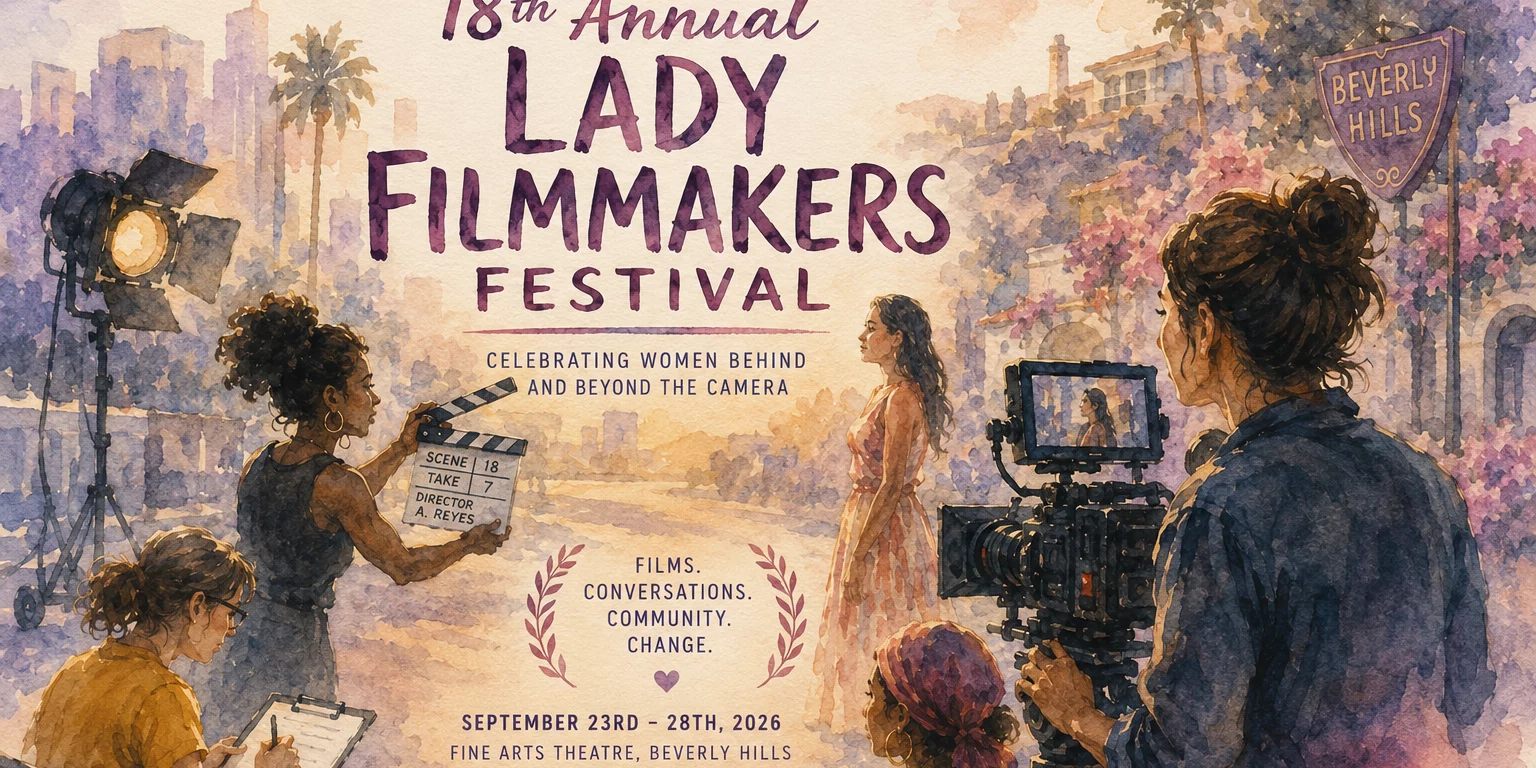
It’s not every day you have the opportunity to attend a critically acclaimed film festival, especially not one that features an incredibly diverse range of projects, from works involving Academy Award and Emmy Award-winning filmmakers to talented young students in elementary school. The Lady Filmmakers Film Festival celebrated its 18th year with a six-day symposium in Beverly Hills including film screenings, workshops, and industry panels. The film festival celebrates female-driven stories, screening films with at least one female-identifying individual in the role of writer, director, producer, cinematographer, production designer, or editor. This year, the festival featured America, a film directed by Laura New and executive produced by Vanessa Hudgens, as well as many more innovative and groundbreaking titles.
I was fortunate enough to listen in on several of their panels, from a panel featuring women behind the camera to one detailing the intricacies of TV production.
The “Women Behind-The-Camera” panel moderated by Patricia DiSalvo Viayra featured Courtney Franklin, Tessa Blake, and Debbie Formoso. Courtney Franklin, a former 1st AD turned director, has credits from Sex Lives of College Girls to How to Get Away With Murder. She’s notably collaborated with people like Anthony Anderson, Miley Cyrus, and Dave Chappelle, and is even working on writing and developing her own pilot project. When asked about her big break, she mentioned that her entry to the director’s guild helped jumpstart her career, and she worked her way up from there. She lives by the motto of “putting into the atmosphere what you don’t want,” which allows her to focus on what she does want. Her intro to directing came from AD-ing an indie horror – “Any asshole can direct.” In her directing process, Franklin believes it is faster to do than discuss, allowing actors to try things their own way instead of debating over the intricacies of a note. “I’m happy to be wrong,” she says. “If you can prove me wrong with all the prep I’ve done, good for you.” I was able to talk to Franklin after the panel and asked her about how her experience as a former 1st AD informed her directing. She told me about the value of time and learning to get things done faster, and how being a 1st AD allowed her to build relationships that continued to support her throughout her career.
Tessa Blake’s first big break came through an early career documentary and was the first instance in which she began to think of herself as a proper filmmaker. After that documentary, she kept writing and was able to direct one-act plays for a theatre company that doubled as pilot presentations for FOX. If she could tell her younger self one thing, it would be to grow and develop broader and deeper relationships with her peers. A support group is incredibly useful, and she advises women to use their social networks to help them throughout their lives. Blake describes herself as an actor’s director, and allows her actors to feel out a scene in the first couple takes, welcoming their interpretations of the script while she deals with the technical side of setting up a shot.
Debbie Formoso has worked primarily in commercials, and originally was a DP during her time at LMU. Her friends encouraged her to become a director after seeing her innate talent for it, and she ended up going to Tribeca Film Festival with her thesis film. Like Franklin, joining the DGA opened up a whole new arena of opportunities for her. Formoso had several words of wisdom for young filmmakers, noting that in filmmaking, “You’re your own business.” That means burgeoning artists must learn to budget effectively and set aside money for the future without the support of a traditional 9-to-5. Formoso started out using film and noted the power of the digital era and social media, as ease of access allows anyone to create. “Don’t wait for permission.”
I also attended the “Ins and Outs of TV Production” panel moderated by Meredith Thomas and featuring Alexandre Coscas, Dana Scott, Alexa Perrera, and Courtney Franklin once more. Alexandre Coscas is a producer and the co-founder of Basset Hound and Reckless Pictures. He has produced and developed multitudes of films and currently has several in production. He started out as a reader doing script coverage and slowly worked his way through the ranks until becoming the producer he is now. The biggest advice he has for filmmakers is to not give up on material that you care about, noting that he pitched an idea continuously for ten years before it finally got picked up for development.
Dana Scott began her career as an actress, earning a BFA in Theater from Roosevelt College. She worked as an actress until she was 30 before pivoting to producing, hoping to create her own production company. She has since become an absolute powerhouse of a producer, working on titles like Beef, Ozark, and Station 11. I asked her afterwards about her experience working on such a critically acclaimed show like Beef, and she mentioned that even though it was incredible to see such amazing reception, the day-to-day work on the show was just like any other. Producing is intense and involves juggling many different tasks at the same time, but that’s what makes it so appealing to Scott. For her, problem-solving is the interesting part of producing, and building a good relationship with the showrunner is pivotal to that job.
Alexa Pereira, a casting director with an incredible breadth of experience, was also featured on the panel. From indie films to Netflix series like Nobody Wants This, she has an eye for talent that makes her an invaluable asset to any production. She noted the difference in casting for pilots versus episodic shows versus movies–for an episodic show, casting usually involves searching for co-stars and more short-term roles, whereas casting a pilot involves higher stakes, creating the framework in which an entire series is built. She emphasized the importance of a table read, which actors should still treat as a job interview for the role. A table read allows for casting professionals, producers, and directors to examine the relationship between the actors, and whether or not a bad read is due to a lack of chemistry or a deficit in the writing. I got to speak with Pereira after the panel and asked about her hardest decision in the casting process. She noted the difficulty of knowing when to say no to a project. It’s okay to let go, and many factors like the script and the attached producers go into making that decision. My biggest question for Pereira, however, was to do with her experience in casting the Emmy-nominated The Muppets Mayhem. I was wondering what the casting process looked like for a show of that nature and if the actors had to do chemistry reads with the muppets themselves. Apparently, however, the actors didn’t audition with the puppets and had to wait to meet them after they were cast.
I learned a lot in a few short hours at the Lady Filmmakers Film Festival and could’ve spent many more listening to the panelists share their wisdom on navigating the ever-changing landscape of the film industry. Fortunately for me, the festival isn’t going anywhere, and will be returning for the 19th time next year. Until then, Lady Filmmakers!