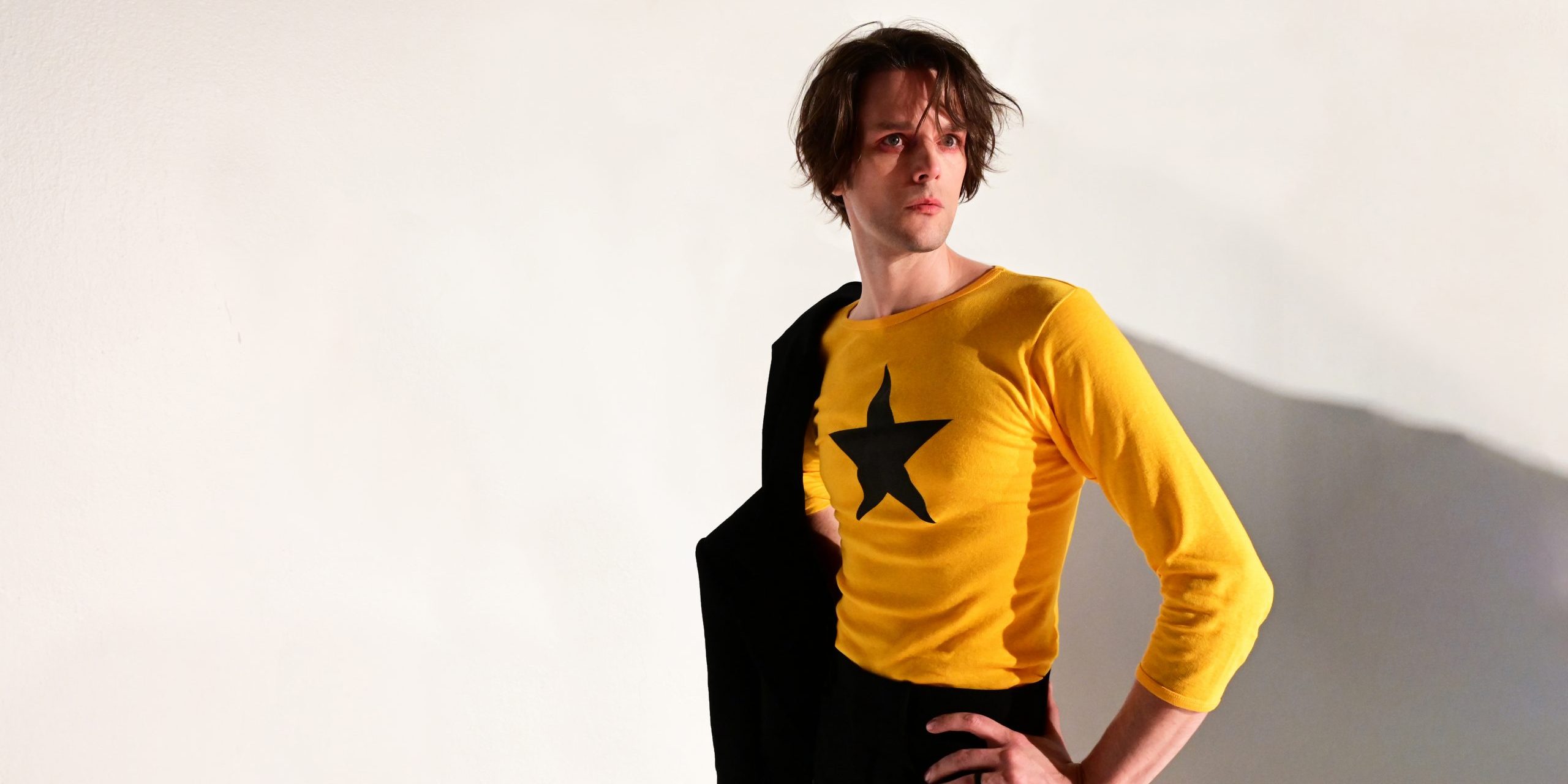
Photo courtesy of Vin Chandra
Interview conducted on 10/26/2026
Utah native Dallon Weekes is no stranger to musical involvement. His projects have spanned decades, from fronting cult-indie band The Brobecks in the 2000s, a run as the bassist for Panic! At the Disco in the 2010s, as well as a handful of releases as a soloist. The epicenter of Weekes’ musical projects, however, is indie-rock/electronic band I DON’T KNOW HOW BUT THEY FOUND ME (iDKHOW). Formed in 2016, iDKHOW has released two studio albums thus far, Razzmatazz (2020) and GLOOM DIVISION (2024), with a third record currently under way. Now, iDKHOW is preparing for three-night residencies each at The Dome in London this December and at the Troubadour in West Hollywood in January – their first headlining shows in a year. I had the privilege of being able to chat with Weekes in light of this new era for both the band and himself.
—
This interview has been edited for clarity and brevity.
Sofia Cardenas: You’re currently in the middle of the recording process for iDKHOW’s third studio album. What stage of development is the album in right now?
Dallon Weekes: I’d say it’s a little over 90% done. I’ve got two songs left to do all the vocals for, and then a few songs have violins, cellos, saxophones, and horn sections…also some background singers. A lot of church choir-y stuff. I’m hoping to have the major tracking done before Halloween.
SC: Super soon, awesome!
DW: Yeah, I’m doing a lot this week. The album’s been a bit delayed since I’ve been helping with music for a movie which is new for me.
SC: Oh wow, that’s awesome! I don’t know how much you can share about it right now-
DW: I don’t either [laughs]! Because I’m so new to it I have no idea how much I can say and how much I can’t, but it’s a sci-fi comedy thing — I got brought in to do some vocals on it. I’m singing as one of the characters in the movie, but I have a soft spot in my heart for this kind of music. It’s inspired by family bands like the Osmonds, the Cowsills, and the Partridge Family from the 60’s and 70’s. I have such a weird affinity for that stuff because my mom was such a huge Osmonds fan growing up — it was always in this peripheral vision, and I was aware of that kind of music. I wasn’t listening at home going like, [mimics listening to music with headphones and nodding], I just know about it.
SC: I didn’t know that was happening! I’m really excited to see how that turns out later down the line.
DW: Yeah, me too! It’s been a super fun process so far.
SC: Something I really loved about GLOOM DIVISION, your previous album, is how much of a matured sound it had from Razzmatazz. For this album specifically, what are any musical influences you’re taking as inspiration to differ from the previous records you’ve done so far?
DW: I think this album is more about changing the approach. My influences and the things I love – I’ve noticed that any time I’ve ever loved something I love it forever. This is going all the way back to when I was a little kid. If I was a fan of Ninja Turtles or He-Man, I still love that shit today. Music, art, and movies as well. Once I’ve connected with something, it sticks with me. Those influences are always there, so the inspirations and sonic neighborhoods are the same. The approach is something I wanted to change. I wanted to go back to how music-making was for me when I was in my 20s in the early 2000s.
SC: Like the Brobecks!
DW: I would show up to the practice space, the “studio” being the garage, with a general song idea. I would kind of work on it throughout the day and by the end, you either have a song or something you can come back and work on the next day. In between those two sessions, you don’t get to take it home and listen to it. So, I’ve been secluding myself from what I do in the studio, and I only work on it in the studio. The hope is you rely more on instinct and gut reactions like you did back then, since you couldn’t take it home, rethink it, and replay it…making notes and thinking, “Oh, I have to change this.” You have this little window of time to work on it, so I’ve been doing that instead.
You’ll hear some really cool results, and I’ve been enjoying the process a lot more too. Past records like Razzmatazz and GLOOM DIVISION — there’s this finite amount of time to make these records. Like, we’re flying into places, we’ve got fourteen days and that’s it. So make your record, go home, and that’s all you get – that time is really stressful. I’ve never really gotten to enjoy the process before, but since moving to California and working with our producer, Jason Hill of Louis XIV fame —
SC: I was going to mention him later!
DW: Yeah, he does a lot of music for David Fincher projects and produced some of the earliest iDKHOW stuff. He lives about an hour away from me so I go down there, and come back home;it stretches out the process a bit. It makes for a more enjoyable process, but the downside is that it takes a bit longer. But I haven’t been so high in anxiety thinking, “it has to be done now!” I’m enjoying the recording process, and I’m feeling really good about where it’s gonna end up. But there’s still some more work to do.
SC: For GLOOM DIVISION, you mentioned around the time of the album’s release that a lot of the collaborators you had were causally acquired with friends in the music industry. I’m wondering with this album, does the music-making process feature the same people you’ve been working with previously? Or are more post-GLOOM DIVISION connections getting involved with this record?
DW: It’s probably more post-GLOOM DIVISION, but the relationships are still there with people I’ve collaborated with in the past. We send song ideas to each other all the time, looking for notes or contributions. But the songs that have risen to the top with this record are with people who I haven’t collaborated with before. Jason Hill who’s producing the record is a past collaborator, but I’ve brought in my live band that joins me on stage to come in and track songs I’ve written for the record. I want this record to feel like how a stage show feels, and it’s something I’ve had a tough time capturing in the past because it’s just been me in the studio working alone. Someone might come in, but I tell them exactly what to do. This time, I’m trying to release some of that control and take a step back. Rather than try to make all of these ideas fit into a box I made in my head, whatever it’s gonna be, whatever the space or studio – the environment and the people – I just let the music be what it is. In that regard, it felt more like a snapshot – like a photo album of specific moments, and it feels good!
SC: That’s great!
SC: Earlier this spring you toured with Boys Like Girls, and have had your own personal things going on this year – I know you mentioned recently moving to California as you’ve originally been based in Utah where you grew up. But now, you have more headlining shows with iDKHOW set for London at the end of the year, as well as three shows at the Troubadour here in LA in January. What are you looking forward to with these shows and how do you feel coming back to fans as a headliner?
DW: It’s strange for me because it doesn’t feel like it’s been that long. It feels like I just got home, but that’s because the process of moving here started while I was on tour with Boys Like Girls. My wife was here doing so much of that stuff on her own, and I’m all over the country via phone trying to help wherever I can. As soon as that tour ended, I was loading trucks and coming over here.
SC: A lot of stuff with plumbing I know you mentioned on social media [laughs].
DW: Yeah! As we were getting situated we had some pipes break and I was busy fixing that sort of stuff. It took a minute to get situated but now I can finally exhale and start writing the record. That process now is almost wrapped up but now it’s time to start thinking about shows and tours.
That’s kind of how London happened. It’s been a minute since iDKHOW’s been over there, and the idea of doing a residency came up, which is another new thing we’ve never done before. All of the past six or seven months, the ethos has been trying to do things in a new way. So, we’re gonna be in London and do a week’s worth of shows in one place rather than jumping around, which I’ve also never done before, so I’m looking forward to being there for the week. I’ve been there a million times, but I’ve never seen it.
SC: You haven’t really gotten to immerse yourself in it yet, it’s mostly just been, “go, go, go!”
DW: With the Troubadour, the opportunity to play there came up – I’ve never played a headlining show at the Troubadour before. With iDKHOW, I think we opened for Neon Trees there years ago. You know, it was sort of more like testing the waters – “Alright, it’s been a minute, how are we doing on ticket sales if we do a headlining show?”
SC: And it’s been going really well!
DW: Surprisingly, we’re doing ok [laughs]! We keep adding shows, and it’s fun. But the challenge is gonna be how we can make each night a little different. It’ll be a lot of work, but we’re up for the challenge.
SC: This question is more in tune with the organization I’m with, but it’s all about college/college music scenes: iDKHOW has been performing a handful of times at different college campuses within the past couple years. What’s that experience been like, especially since you can’t guarantee that the crowd will be familiar with iDKHOW. How has it been performing in front of audiences – younger audiences specifically, as a new group for people to get introduced to?
DW: Sometimes it’s a challenge, but it’s one that I think we thrive on: chaos and uncertainty, and a room full of people with their arms folded going, “show us what you got.” That sort of feeds the fire for us a little bit. In a very non-confrontational sort of way, because we’re here to entertain you and win you over…and to maybe get some money out of your wallet for a t-shirt [laughs]. It’s a process I enjoy, going to play for a crowd that isn’t necessarily our crowd. I enjoy winning people over a lot, especially the ‘big guy with the Oakley glasses in the back.’ That’s not our normal demographic, but as he continues the show with his arms folded and chin turned away, it’s a really cool thing to see that soften. By the end, he’s checking with his buddies going, “Hey this is pretty alright!” I love to see that happen, but sometimes you get paired up with wild lineups.
SC: That was actually going to be part of my next question! I was going to mention when you did a show opening for NLE Choppa at the College of William and Mary [laughs]! I’ve been wondering if you learned something from that show specifically? Because you guys are like, two completely different artists and genres. Was it a learning experience playing in front of a crowd that’s vastly different or expecting something different from you considering who the headliner was?
DW: Yeah, or just is, fully prepared to not enjoy what you’re gonna do – the reason they’re there is so antithetical to what you do. Like, I still don’t care. I love that challenge and energy, seeing the softening happen. But when the crowd is determined to be like, “Get the f*ck out of here!” – it’s not a new thing. I mean if you do this, being a performer of any kind, you have to be prepared for that. Anticipate it sometimes based on the shows you’re going into. The worst one of these I ever had was opening for Twenty One Pilots in Chicago.
SC: Really?
DW: Yeah! This was when iDKHOW first got started, and it was a radio show. iDKHOW was new enough to where we only had a 5 song EP out at the time.
SC: Oh, 1981 Extended Play.
DW: This radio station hired us to open for an hour before Twenty One Pilots, who at the time were beginning to become the biggest band in the world. I don’t care who you are, opening an hour-long time slot for the band everyone came to see is not an easy job to do.
SC: Yeah of course. You really need to win them over with a performance that long.
DW: 45 minutes is the most you should be asking of any opener for a show like that. By the time 45 minutes began to roll past, we only had 5 songs out so I was talking way too much. I was trying to stretch every bit of time we had just so we could hit that hour mark we were contracted to play…and we barely made it out of there [laughs]. But we still gained some fans out of that show and the people we connected with and they’re still around today, so a win is a win!
SC: I really wouldn’t have expected that to go so badly, since I feel like there’s such a big intersection between fans of Twenty One Pilots and iDKHOW.
DW: There is, but I think the conflict really came from just the amount of time we were slated to be on stage. And the fact that we were so new, we didn’t have enough material to really fill that time. I was ‘tap-dancing’ a lot [laughs] – I can hardly blame people in the crowd going like, “what is this?”
It’s not always entirely unwarranted. I think of myself as a fan of music too. I go to concerts and I know what the rules are too as an audience member – how much I’m prepared to tolerate from an act I’ve never heard of before…unless they’re up there really wow-ing you, which is what I hope to do, but some nights hit better than others. That’s just the nature of the beast, I guess.
SC: Being the frontman of a band as a bassist is rare, especially within the rock music scene – especially considering that they’re either playing guitar, piano, or no instrument at all. Has being a frontman and bassist affected your music making process in any way?
DW: Yeah, because I do consider myself a bass player and not just a frontman. I love playing bass, I fell in love with it when I was around sixteen or so. I saw the Ben Folds Five play-
SC: How do you feel about their reunion tour, by the way?
DW: They don’t have any west coast dates so I’m really hoping they come over this way. Or else, I’m just going to have to fly out to Texas, or wherever they’re playing because I’m such a big fan. Robert Sledge, their bass player, is such a hero of mine. I saw him do all this crazy stuff on TV and I switched to bass guitar the next day. It’s just fun, I love it. And it’s just better than guitar.
SC: I agree, I play bass as well [laughs].
DW: Right on! Sometimes when I’m in the studio I have a habit of approaching things as the bass player, and a bad habit of always trying to do too much. But then you also have to think, “OK well, at some point I have to be on stage not only playing this, but singing as well” [patting head and rubbing stomach]. I’m OK, but I’m not that good [laughs], so I have to pick and choose sometimes. That’s why Isaac, a member of my live band plays guitar and bass too, so I hand it over to him sometimes so I can do the singing portion – and that’s a whole lot of fun too. I love both in equal measure.
SC: Your first album, Razzmatazz is 6 years old now! One of the tracks, “Need You Here” is all about the relationship you have with your family – which I can assume is very hard as a father and a husband, having to leave them on tour. But looking back on it all these years later, especially since your kids are much older, what’s the dynamic like now?
DW: They’re the reason I go out into the world and do any of this. Music used to be for me, the first thing that really connected me to the human race. I’m a neurodivergent person, so I always felt like I was on the outside of the human experience. Music: falling in love with The Beatles, playing guitar, that was the first thing that allowed me to bridge the gap between me and everyone else – it allowed me to participate. It was this thing for me that allowed me to tap into that. But becoming a husband and a father, your own sense of priorities shift. Music instead became the way that I take care of them, and that’s why I do it now. I still love it, it still is that bridged gap for me too. But the biggest reason that I do it is because it’s the best way I can take care of them – it’s the best way I know how.
That doesn’t make it easy to be away from them on the road. It’s a challenge, but having them come out and visit is something we try to do whenever we can. But as they’ve grown up we’ve [Dallon and his wife, Breezy] encouraged them to know that whatever they want to do and whoever they are – that’s what we want for them. Both of our kids are incredible artists and musicians. They both dabble, but the challenge for me is to not be like, “Yeah, do that! Go, go, go!” I don’t want to pressure either of them to do anything, but they both have this natural ability and affinity to do music and art. Anytime they show an interest in something, I’m just there to be like, “F*ck yeah.”
SC: Going back to Jason Hill and Louis XIV, I wanted to ask this question as someone who grew up listening to this band! I know you’ve mentioned before being very influenced by his music, but how is it now that you’ve built a relationship with him as a collaborator on your music and playing shows together?
DW: It’s a strange thing that happens over the course of doing music for a long time. Some of the people you admire become people you know, or people you work with. It’s strange, but it’s very cool too, and to collaborate on things with artists whose work you admire and that’s influenced you. How special that is and how lucky I am – that is lost on me. I’m under no impression that I’m where I’m at in my career and in life because I’m so great. It’s really just a matter of luck and being too stupid to quit. If you don’t quit, your chances of lucky things happening to you go up, but it’s winning the lottery – that’s what a career in this business is. It’s a winning lottery ticket, and I feel like I keep getting these tickets and scratching them off and, “Holy shit, there’s just enough for me to keep going!”
SC: [pretending to scratch lottery ticket] “And oh my god, it’s Jason Hill!” [laughs]
DW: It’s insane and so bewildering, but in the best way. Like, making a song in the studio with this man who’s done all this work that I’ve admired for a long time and that’s influenced my work – and to be able to write with people who I’ve been a fan of since I was 19 or 20, it’s really special and I feel lucky.
SC: That’s really cool! When I was getting into iDKHOW’s music a super long time ago – I don’t know if it was intentional or not since I know Jason Hill was a collaborator on 1981 Extended Play, but was “Bleed Magic” inspired by “Finding Out True Love is Blind” (a song by Jason Hill/Louis XIV)?
DW: Actually, yes, but it was a subconscious not-on-purpose thing. I had been collaborating with Jason on a couple songs but not that one. I came up with a beat for it and was like, “Yeah, this is cool.” It wasn’t until the mixing and mastering process where my brain made the connection of “Oh shit, that beat is from a Louis XIV song.” I had to email Jason and be like: “Hey man! This happened, and it’s not on purpose.” And he knew me well enough to know that was the case.
He was very gracious about it, but there is something that happens with art-making and music in particular that things sort of bleed into what you’re doing – you hear it all the time. A couple years back, there was an Olivia Rodrigo song, “Brutal,” that sounded like Elvis Costello’s “Pump It Up.” From what I heard, she didn’t know that it was already an Elvis Costello thing. There’s artists out there like Jason Hill and Elvis Costello that know this happens and go: “You know, I do it too. I got what I do because I ‘rip-off’ this person and that person…you mash it up, put it in a blender and do it all your own way.” That’s what all of this is.
I don’t remember who said it, but it was something about “talent borrows and genius steals.” That ‘borrowing’ and ‘stealing’ is subconscious because your influences have their ways of creeping into what you’re doing, whether you’re trying to or not. As long as you’re doing it honestly, that’s the important bit.
SC: I’ve also wanted to ask this as a fan of both bands – iDKHOW and Sparks, which is fitting since they happen to be UCLA alumni. When I was first getting into iDKHOW, I was neck deep in an 80s new wave and post punk phase, which are genres I know you draw from a lot in your music. So, I was wondering since Sparks have such a long discography and history as a band, is there any work of theirs in particular that you find yourself drawing from in your work?
DW: Yeah, there’s albums like Kimono My House and Propaganda that are legendary and have influenced so many people, that most fans of music don’t even know about. Like man, Queen took a big page out of the Sparks playbook, and so many other people have, they’re fantastic. I got a chance to interview Sparks during Covid and it was so cool, because I’m such a big fan. Propaganda and Kimono My House are my favorites, but they just crank music out.
SC: Yeah, it’s like every year they have something new that’s coming out.
DW: They did a song from a movie with Adam Driver (Annette) called “Can We Start,” which was fantastic. I also really liked Hippopotamus and A Steady Drip, Drip, Drip. They’re one of those bands that have been making music for so long and have been so prolific about it that it’s hard to really consume all of it.
SC: Yes! I’m still managing to find new music of theirs too.
DW: You can always find these gems that sound out and connect with you thinking, “Oh my god, when was this one made? This was made 30 years ago, that was made 3 months ago.” It’s so impressive, and I hope to be still creating and have a career somewhat comparable to that, but I’m nowhere near as prolific. I’m too choosy and picky, it takes me forever to do stuff but I’m also fixing pipes and moving families [laughs].
I’m a big fan of them, but there’s another band that’s sort of similar output wise. It’s really just a guy, but are you familiar with Guided By Voices?
SC: I am!
DW: They’ve been making music since ‘88. They’ll just crank out songs and songs, records and records. It’s another one of those where there will be three to four albums that are flawless from top to bottom. Throughout the rest of their career – even if the lyrics don’t resonate with you, they’ll still drop these gems so regularly.
Want to get ready for iDKHOW’s new album? Check out their discography here!