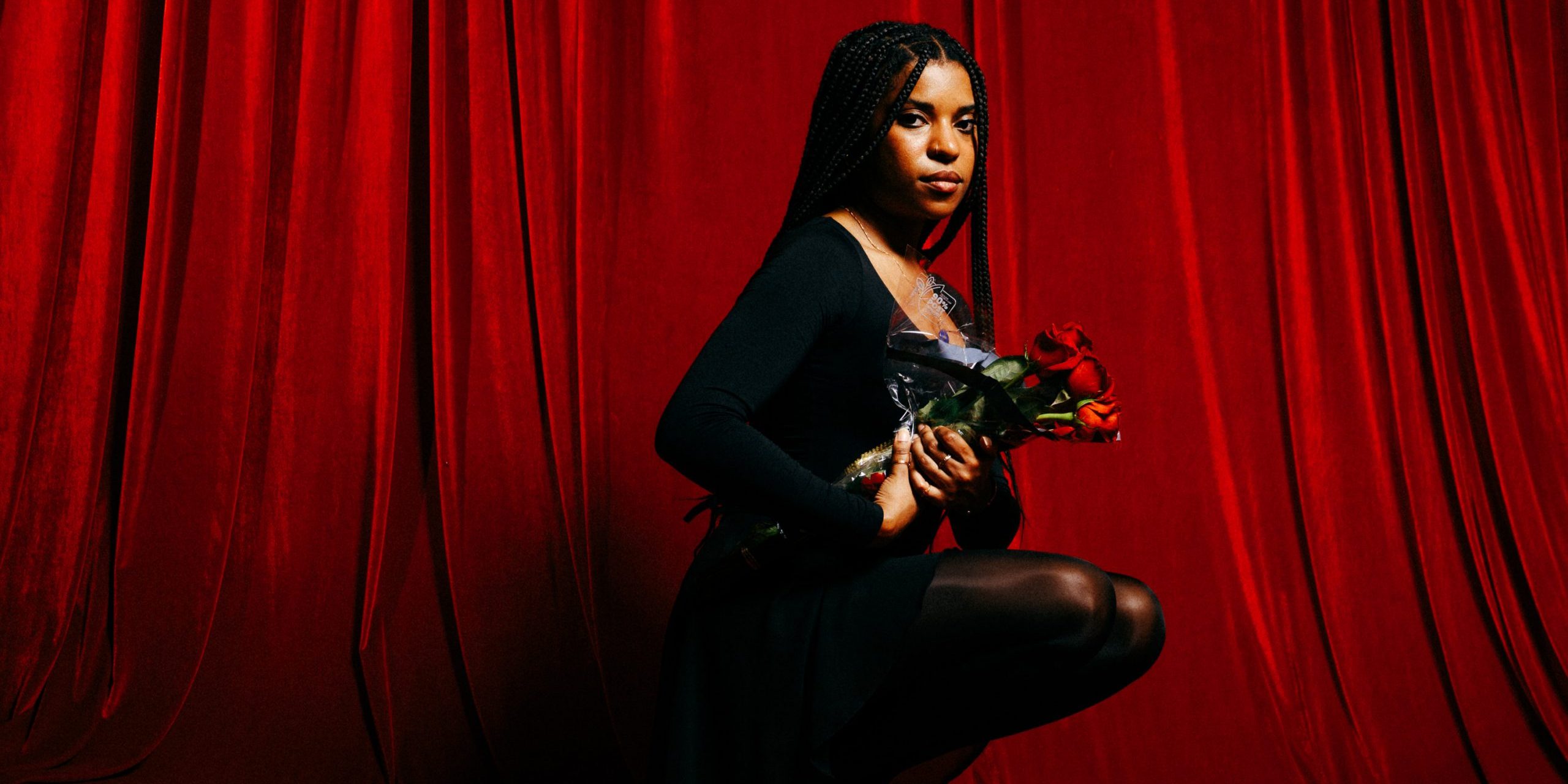
Dani Offline is a songwriter, producer, and multi-instrumentalist whose music draws from R&B, soul, and jazz to create a unique and captivating sound. Following her self-produced debut EP, Mirror (2023), she released her first full-length album, Lover’s Discourse, on September 25, 2026.
While on tour for Lover’s Discourse and pursuing her PhD at UC Berkeley, Dani Offline joined me at UCLA Radio for an interview on The Bins. I had the absolute pleasure of picking her brain about the creative process behind her debut album, her musical influences, and how her relationship with movement, improvisation, and spontaneity continues to inform her artistic practice.
Conducted on October 23, 2026 by Michelle Cheng. This interview has been edited for brevity and clarity.
Michelle: Hi Dani! We are so excited to have you in the station to do an interview and play a few of your songs today here on The Bins which is a show from UCLA Radio’s programming department.
Dani Offline: Thank you for having me Michelle!
Michelle: We’ll start with the album you’re touring with right now, Lover’s Discourse. How were the ideas and themes conceived? When did they start? Where did they start? And how did it manifest into all the different songs in the album?
Dani Offline: This album to me feels like the culmination of a couple different years, probably my early 20s. Ultimately, I got to a point last summer where I had an idea for the album that I wanted to put out, and I felt I had songs that tell a story, so it was a process of collecting a bunch of different fragments. Songs that I had written, poems that I’d written, notes app things, improvising at the piano, really long voice notes, and altogether, I feel like it created the album.
Michelle: I totally relate to that. As a dancer, I think that I feel like the best ideas kind of come from a whole journey, especially improvising and growing ideas that way. When you say improvisation, would you consider even the notes app and poems to be that?Do you purposely try to sit down and form ideas for the project or is your process more fluid where whatever happens happens?
Dani Offline: That’s such a good question. I feel like it’s really spontaneous for me. It’s spontaneous, and then I sit down and think it’s time to form this. Almost like working with clay. I feel like when I come up with a song idea, a lot of the time I’ll be in the shower or driving.
Michelle: Oh my gosh, for sure.
Dani Offline: Yeah, just places where I should not be writing at all, and I very frequently will turn on my voice notes and just sing in the shower, sing in the car, sing in front of the piano. I grew up listening to jazz music a lot, and then I studied it in school, and so improvisation was like a big part of what I studied, and it was so freeing. And I feel like I kind of came to the songwriting game a little bit later. Yeah, and so I sort of just started with the tools that I had.
Michelle: That’s super cool. I feel like you can definitely hear the jazz influence in your songs. What would you consider- not that you ever have to, but if you were to tell the listeners what genre your music falls into, how would you describe that?
Dani Offline: Oh, this is so hard. I feel like my music is very classic R&B, and I mean R&B in the sense of if you were listening to the radio in the 1970s, I feel like my music would be on an R&B station. But I also feel very influenced by jazz, and I see jazz as a very liberatory genre that has an expansive concept of what music can be. I’m very inspired by jazz. I mean, straight ahead jazz, more contemporary stuff, even more spiritual jazz. I love Lonnie Liston Smith and Alice Coltrane, and I feel like my process is similar in a way. I’d say jazz is the thing that I come back to a lot.
Michelle: I totally get that because at least for dance, realizing whenever I improv, I’m creating something that has never been done before, it’s super special. Even if you’ve taken inspiration from other people, it feels very liberating in that way of “I’m creating something and it feels very authentic and honest.”
Dani Offline: Yeah, it’s a good feeling, and I feel you at dance because I grew up doing ballet. And then I remember doing dance intensives. We did contemp stuff, pointe, pilates. Yeah. And I remember for our recital, we did a routine to Donna Summer’s “Last Dance”.
Michelle: No way!
Dani Offline: And it was the most fun thing. I mean, I love the song, but it was very Martha Graham. Yeah. We were all just improvising, and it was some of my favorite things at Lincoln. I definitely feel like I still feel like a dancer in that way. I love to move my body, and I feel like I think of music as a dance also, and I think about how I would dance to things a lot.
Michelle: That’s awesome. I have two friends that make music that feels so danceable and I always try to explain exactly what makes it that way. I love music that feels full with layers to kind of explore in your body. I think the ability to do that and have that reflects so much in your music, which is so awesome.
Dani Offline: Thank you. Yeah, I think about my body, alive.
Michelle: No, that’s so real. Your body is giving you so much information all the time.
Dani Offline: I feel very existential about it sometimes. Yeah, and then I also feel being alive, in my body, it feels like the biggest lottery ticket draw of all time. I don’t know. It also hurts to have a body. Bodies are so weird, but also I love having a body, and I love what my body can let me do. It’s a good vessel.
Michelle: Body in relation to art is such a crazy thing. All these feelings and being able to express it in the mediums that we have the technique to, I feel very grateful to have that combination of feeling plus expression all in one place.
Dani Offline: Totally.
Michelle: Okay, awesome. How do you think performing the songs has kind of developed either the themes even further in your mind? How do you feel in relation to the songs now vs when they were first made?
Dani Offline: I love this question. I’m always thinking about performance and live music, even when I’m making music. One song on the album, “Desire,” was recorded in just one take, straight to tape at Santo Recording in Oakland. I love recording that way. Usually, I’ll start writing on an instrument, produce the song a little, and then bring it to a band. I love performing songs live long before I release them. I also think like an arranger or bandleader: Who would I want to take a solo here? Could we do a weird intro or outro?
That’s been fun on tour. With “Rewind,” for example, we do a cut-time outro. I tell the band to think “chopped and screwed,” like the tape is spinning out. That’s something you can really play with in a live setting. I love to just destroy my own music and see what comes from it. It’s a good feeling.
Michelle: Do you typically work with the same musicians when recording in the studio and performing live?
Dani Offline: Yes and no. For this album, it was really just me and Vu, who executive produced it with me, and Omari Jazz, who came in for sound design and co-production. Every song had a maximum of three people working on it, and I love that intimate way of making music. But I’ve also played with a band in Oakland for a long time, and now I have an LA band that’s starting to come together. This tour has been interesting because I’m playing with a different band in every city, so I’m arranging and teaching the music to new musicians. It’s interesting how differently the songs can sound depending on who’s playing them, and I kind of like that.
Michelle: That’s super cool. We’ve talked about the performance side, but now on the studio side, you’ve alluded to that there’s normally the three of you. In terms of production, what are some of the big things that you look for sonically? What kind of world are you trying to build?
Dani Offline: I love this question. I feel like I’m a very selfish artist in the sense that I’m making music for myself. I’m always making things I would want to listen to. It’s a combination of my influences and the sounds I like to hear, that feeling of real expression: This is me, and this is what I have to say.
At the same time, I think about materials. I love collecting vintage instruments, so you’ll hear some of the same ones on every track: Rhodes, Wurlitzer, my Juno-106, and acoustic piano. I have a Yamaha piano at home that I love. For this album, we also had guitars lent to us from Norm’s in Tarzana, including a beautiful 1964 Gibson that Will played. That’s part of my sound. I have my own perspective as a twenty-something in the 21st century, but I also love putting old instruments on a track and seeing what we can do.
Michelle: So cool. Now to move onto your education, you went to Princeton for undergrad. Are there any specific moments in college where you realized I really want to pursue music? Were there any moments or mentors that pushed you during those years of your life?
Dani Offline: It was a combination of a couple of things. I did radio in college. I had a show with my friend called Spicy 103.3 FM, and that gave me even more of a love for music and musical communities. My station, WPRB, had a really great vibe. My bassist in Oakland was at the radio station with me, too, and that’s how we became friends.
I was also part of the jazz program. Jazz at Princeton was buttoned up to the top. It was a little more of a conservatory atmosphere, but I had an amazing mentor, Dr. T, who’s now at Berklee College of Music in Boston. She really opened my mind. It was my first time having a musical mentor who was a Black woman, so that was important to me. I grew up playing classical piano and doing opera, and although I loved jazz, I hadn’t really sunk my teeth into it. I felt like a novice compared with people who had more jazz training.
The third thing was having musician friends. When I first put out a project, I remember asking a friend, “Yo, how do I get my music on Spotify? What did you do?” It all felt new and exciting. Seeing other people make music and put it out made me realize, okay, this is possible. At first, I wasn’t taking it very seriously. I was just having fun.
Michelle: I love that, shoutout college radio! Well, that’s your undergrad side of the school part, but right now you’re pursuing your PhD at Berkeley, which is incredible. How do you feel about this music life of yours and then the PhD life? Do you keep them separate, or do you kind of try to blend them together, or do they start to blend together? And do you want to keep them separate?
Dani Offline: Yeah, people ask me this a lot, and I feel like it’s just all tied up for me, which I kind of like it like that. I think if I kept my art and my scholarly practice separate, then there would be a hierarchy, but for me, it all comes from the same source. It’s all a practice of expression. Whether I’m writing words, or I’m writing a song, or I’m improvising at the piano, or I’m reading a book. I kind of like that it all comes from the same place, and then it’s just a question of how it gets out. Maybe in the future, I might have to divide things a little bit more. I definitely am feeling like I have to turn my brain from one side to the other, depending on where I am in the state of California. When I’m in NorCal, I’m in my student bag, but then I’ll have to do rehearsals and have an idea for a song. It all gets mixed up anyway. Even when I try to focus on one thing, I guess my brain just works like that.
Michelle: You’ve talked about your background in classical piano and jazz. Do you feel like having that technical foundation gives you more freedom to create your own sound, or can it sometimes feel confining?
Dani Offline: I’m glad that I have that technical background, but I played classical piano for years, and I was never very good. It was something I had to be dragged to until I got into jazz music. I feel like technical skill can allow you to express yourself better, but it can also really hold you back. Music theory is a really good language to speak, especially when I’m playing with different bands, but there’s this intangible feeling that sometimes technique can get in the way of. At the same time, I love the discipline of classical art forms. There’s something almost spiritual and meditative about doing the same small thing over and over again.
Michelle: I totally relate to that when it comes to ballet. I’ve grown to love it so much more now that I am deeper in the concert contemporary world.
Who are some of your biggest inspirations, either of all time or right now, when it comes to your artistic journey?
Dani Offline: I have a lot of different influences. My parents, especially my mom, listened to a lot of ’70s soul, like The Delfonics and The New Birth. In college, I got deeper into that music and started listening to Roberta Flack and more spiritual jazz. I love contemporary jazz, too, especially Cécile McLorin Salvant, and neo-soul artists like Erykah Badu. I’m the biggest Jill Scott fan ever.
And of course I love classic jazz vocalists like Sarah Vaughan and Betty Carter. Sarah Vaughan’s improvisation especially taught me to use my voice as an instrument. When I take a vocal solo, I think of my body as a saxophone, flute, or trumpet.
I also love hip-hop, and weirdly, that was my introduction to jazz. My dad put me onto A Tribe Called Quest, specifically Midnight Marauders. I started digging into where the samples came from, and that led me further into jazz.
Michelle: That’s so awesome. It’s so interesting learning about everyone’s history and their DNA of where their inspirations come from. I love that. This is a nod to my show that I do called Studio Stories. What are some of your favorite memories, either in the studio or performing, that whenever things are going rough, you turn back to and think this was so fun.
Dani Offline: The thing that’s coming to mind most is “Tell Me,” which you just played. The vocal solo I take toward the end is just one take. I had a demo that was basically a rehearsal recording of me and a band, and when it came time to lay down the drums, keys, and vocals, I improvised to fill some of the space.
I remember feeling scared and not knowing why, because I thought it was just going to be a placeholder. But I closed my eyes, sang, and let the music flow through my body. I felt like I really went somewhere. We talked about doing another take and really getting it right, but I had this feeling that I could never do that moment again. So we left it as it was. That’s one of my favorite studio memories: closing my eyes and feeling like something important was about to happen, almost like being at the top of a roller coaster. I remember thinking, why? It’s not that deep. But it was that deep.
Michelle: Yeah.
Dani Offline: It changed my process as an artist. I view even little moments like that as important. The same thing happened in the theater, we did it in one take and didn’t change anything. Now that I know things can happen that way, I value the first take a little more.
Michelle: That’s like magic. I keep relating everything back to dance, but that’s just how my brain works. I feel like knowing that those moments are ephemeral in a sense that this is going to happen and then it’ll leave, it forces you to be super present. If this is good, then that can just be the moment. I think that in art, whenever that happens, it’s so special. It’s literally magic.
Dani Offline: Because you don’t overthink it.
Michelle: Yeah,
Dani Offline: It’s that pure, almost like psychic expression.
Michelle: Yes!
Dani Offline: Where you’ve never done it before, and you kind of let yourself go. You’re like, okay, well, I’m gonna make mistakes and I think that is really special.
Michelle: Yeah, my friends and I love talking about honesty in art. I think that when you have, not necessarily the pressure, but the thought of “this is going to be it,” it’s a good way for you to really just, whatever you’re feeling, let it out. You can’t think I can try it this way and then this way and this way and break up that feeling into little pieces.
Dani Offline: I think it’s why live music hits the way it does. You can’t redo it. You can’t press pause. You just have to let the moment happen. As I go forward with my practice, I want to embrace that live feeling more. It’s also better for my love of music and my mental health to accept that I’ll make mistakes.
Michelle: Yeah.
Dani Offline: I will fail, and like I’m gonna put it out anyway.
Michelle: Oh my goodness, yeah. I’m sure putting out music, it’s hard because you just want it to be perfect. At least my I’ve that’s what my friends have voiced.
Dani Offline: Yeah. I had a moment where I was just in the shower. I wouldn’t even call it meditation because it really wasn’t that deep. I was like closing my eyes in the shower. I remember having this voice being like, “Just give up, give up.”
Michelle: Oh no!
Dani Offline: No, but in a good way. I was feeling anxious about life and what it all meant. And I felt like it just gave me permission. Like just give up. Literally release, receive, and I think “give up” is such a funny phrase because it’s like “give” and “up” which are both positive words and so it felt like a download. I was like, I give up. I don’t want to be perfect. I just want to be me. I just want to make music, and I literally want to give it to them.
Michelle: So beautiful. Wow.
Dani Offline: I don’t know. That’s how I feel. I know it’s deep.
Michelle: No, but it is that deep. And it’s also that simple. It’s something anyone can do, but you have to let yourself do it.
Dani Offline: It’s like when you do yoga and you do savasana and you lay on the floor, and you’re like, maybe this is why I came. Maybe I just needed to do this.
Michelle: This is also something I do on my radio show that I’m gonna do here too. Would you mind giving us all of us a movie rec, a book rec, and a song rec?
Dani Offline: Okay, movie rec, book rec, and a song rec. For the song, I’m going kind of deep-cut. Cécile McLorin Salvant does a cover of Kate Bush’s “Wuthering Heights.”That song is so transcendent, and I feel like I need more people to talk about it with. It’s beautiful and ethereal.
My book recommendation is always Sula by Toni Morrison. It’s such a beautiful book, and if you’ve read it, you know the last page will change your life. It’s a book that changed my life.
And for a movie? Honestly, it’s October. Y’all should be watching Coraline.
Michelle: Wait, speak on that!
Dani Offline: I don’t care how many times you’ve seen it. Watch it again. That’s what I’m going to be doing.
Michelle: I need to make those little pumpkin cookies, and then watch Coraline and The Nightmare Before Christmas or something.
Dani Offline: Oh my god, yes!
Michelle: Well, thank you so much for joining us. For the listeners, you’ve been listening to The Bins. This was a special episode with Dani Offline. We hope you enjoyed it. Bye!
Dani Offline: Bye!
Listen to Lover’s Discourse below!