
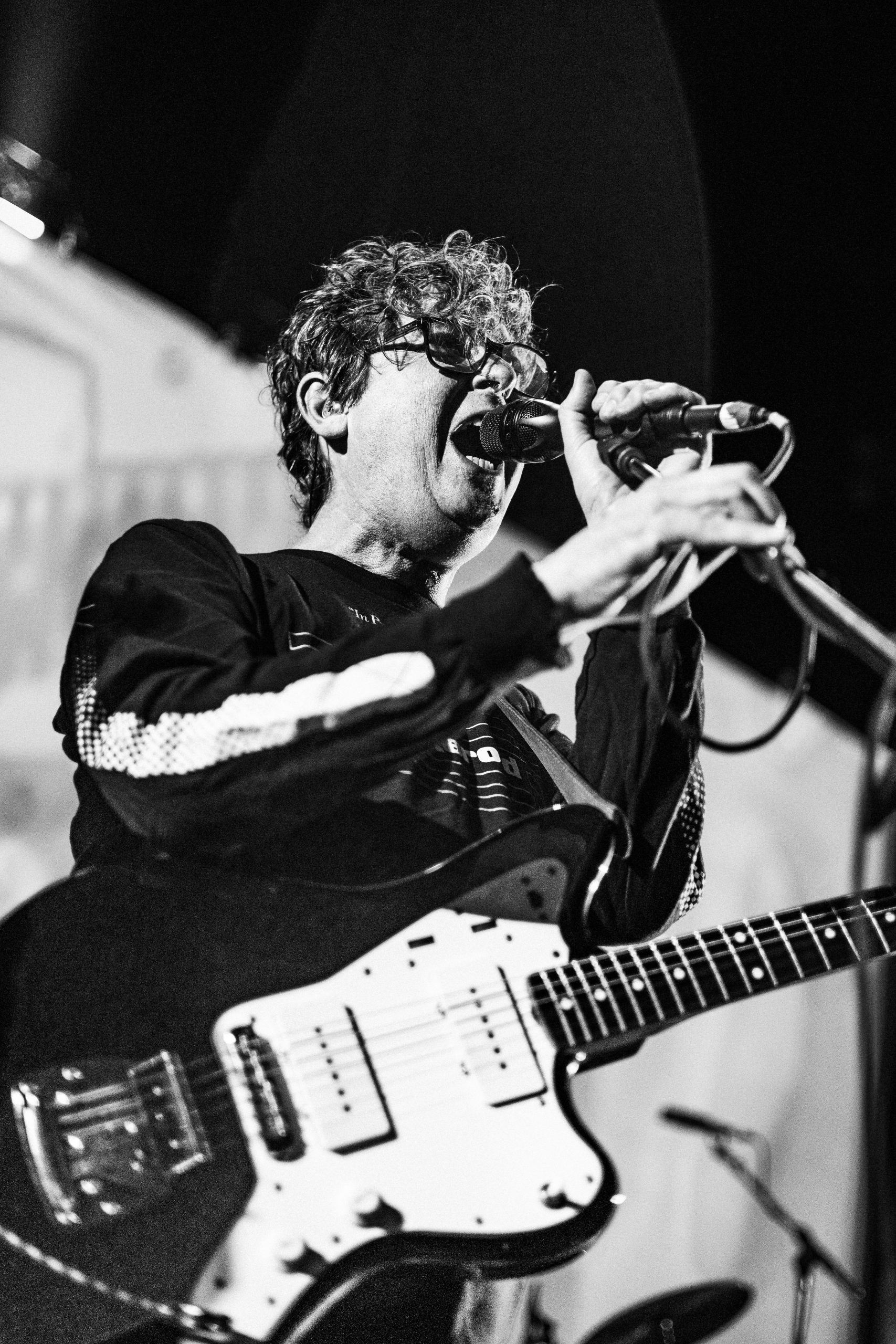
Photos by Dylan Simmons of Chapterhouse at Slide Away Los Angeles (5/29/26).

Chapterhouse is Stephen Patman (vocals, guitar), Andrew (“Andy”) Sherriff (vocals, guitar), and Ashley Bates (drums). The English band formed in 1987, and their debut album, Whirlpool (1991), fundamentally shaped the origins of the shoegaze subgenre. Despite the group disbanding in 1994, their discography still holds up, with Whirlpool maintaining its standing as a critical work of alternative music history. Performing live for the first time in 16 years, the band has reunited for a series of shows across the UK and US, centered around their appearances at the Slide Away shoegaze festivals in Brooklyn, Chicago, and LA. I caught up with Patman to chat about touring, the band’s legacy, and the enigmatic evolution of the shoegaze scene.
—
Interviewed by Dylan Simmons on May 11, 2026. This interview has been edited for clarity & brevity.
Dylan Simmons: You just got back from a UK tour. How’s that been going so far? How does it feel to be on the road again
Stephen Patman: It went really well. The first show in Glasgow was the first we’d played since San Francisco in 2010, so it was a nearly 16-year gap. We spent four weekends over four months rehearsing, because we live in pretty distant parts from one another in the country. We found a central point, a residential recording studio that we could all go to for three days, Friday to Sunday, and really hone in on it. By the time we’d finished, we felt pretty confident about how it was sounding. The shows went surprisingly well in the respect that the crowd was just really great, and a really good mix of ages and people. There [were] people from back in the day, but there was [also] a lot of young people there. The final one in London was on the anniversary of Whirlpool on the actual date that it came out 35 years ago, and that was a big venue with lots of old faces from the past. Rachel [Goswell] from slowdive joined us to sing “Pearl,” which was really nice. She did actually come to some of the rehearsals, because she lives near where we were rehearsing, but she hadn’t sung on stage with us since the early ‘90s. So that was really nice. And yeah, just lots of great friends that we’ve not seen in a while. That was probably the most special gig in some ways, just because of the friendship side of things. But all of them went down really well.
Dylan: That’s so awesome. I know it’s obviously been a while since you’ve been on the road, and a lot of artists talk about how draining [touring] can be. I’m curious how that feels for you now, with the band separating and reuniting over time, and this being its own special stint of shows, rather than decades of [constant] touring.
Stephen: Well, you know, we’re not getting any younger, so it’s mostly more straining. But, to be honest, these UK shows were seven shows in a row, no gaps, and we got through that pretty well. Few learning curves as far as how much we can party after the shows [both laugh]. It’s when you got to get up for the next one, the next day, you learn what your limitations are. But I think we’re in a really good place, just because we did a good amount of rehearsing. I think the hardest thing was for Ashley, who wrote a lot of those drum parts when he was like 16, 17, and they’re pretty intensive, so he works really hard to kind of get back on form. And he’s playing as good as ever. In many ways, we sound better than we’ve ever sounded.
Dylan: That’s amazing.
Stephen: I think that’s just due to the fact that we’ve been in music for like 40 years. Me, Andy, and Ashley have been producing music for the last 30 years. We’re far more advanced than we were back when we were in our early 20s. We’re planning to take this through to the end of the year. We’ve got quite a few things ahead of us after the US tour — we’ve got South America in September, October; and then we’re going to Japan in February; and then hopefully onto Australia. And then next summer, hopefully a bunch of festivals, and back to the States next April, May.
Dylan: That’s really exciting. It sounds like you’ve really honed in [your] sound.
—
Dylan: You were mentioning at your UK shows seeing a lot of old faces, but also a lot of younger people in the crowd. Taking breaks in between the band being together and then not touring for like 16 years, [and] the music industry is always changing so much– I’m sure it feels like everything is so dynamic and so different every time you get back on the road. You guys are obviously credited with part of the birth of shoegaze, which has become such an iconic kind of subgenre. How [do] you feel about how that genre or scene has changed over time?
Stephen: It’s quite difficult to get an overview, in some ways. Because when we were called shoegaze at the time, it was basically a slur, an insult from the music press — it was a bit of making fun of us. Really, what was considered shoegaze at the time was four or five bands, and they used that term as basically ridicule. The fact that it’s become a musical genre in its own right, it’s kind of amusing in some ways. Also, the boundaries of what’s considered shoegaze have broadened considerably over the years. There’s a lot of bands that are considered that now, which I would question. I think it’s become something completely separate from what we were doing. What’s considered to be shoegaze doesn’t have very much to do with us in many ways. When I hear bands that are under that banner, I can see why it’s included. What’s considered shoegaze now is pretty much anything that’s kind of got a wash of noise and dreamy vocals. But then there’s like doomgaze, gothgaze, metalgaze, and so much stuff that’s sort of included. What I hear of bands now, there’s a few that I like, and some that sound kind of like they just want to sound like slowdive and don’t have a great deal of substance to them. I think we always pushed the boundaries of what’s considered shoegaze in many ways, more so than some of the other bands that are considered that, because we took on different musical sounds. We embraced electronics, dance, groove music, and also noise. So it’s hard to pinpoint exactly what shoegaze is now, but it’s nice that people are into it. I mean, my daughter just turned 15, and her friends are big fans of that sound. So it’s nice to see that people are really into it.
Dylan: Yeah, I feel like it’s definitely snowballed, like you’re saying, [into] something very different. But I think it wouldn’t be where it is without all of the early bands that were the inspirations and influences for all of these spin-off subgenres and whatnot. Looking at [the] 2010s, 2020s, I was wondering if there were any younger bands — whether shoegaze or adjacent to it — that you were really digging.
Stephen: Well, it’s kind of odd, because I think all of us in the band probably don’t listen to shoegaze; it’s not something we really get drawn to. There’s some bands that I like, like she’s green, who’s supporting us on some of our headline shows in the US. They’re playing on a couple of the Slide Away festival nights, but they’re going to join us for Washington, Boston, Montreal, Toronto on our headlines of Whirlpool 35 shows, and they’re really nice. The Asteroid No.4 are opening for us on the West Coast, at Seattle, Portland, and San Francisco. And the reason we chose them is because we like them. My daughter asked if I could get something signed [by] she’s green for her [laughs]. She’s really into them. But [shoegaze], it’s not a style of music that I particularly get drawn to listening to — I suppose maybe because I’m too close to it. Everything that I’ve heard over the last 15 or so years, it reminds me so much of who they’re influenced by, that I find it quite hard to embrace it. I need music to have a bit of a mystery and to take it somewhere that’s challenging me. My musical interests kind of lie in a broader spectrum.
Dylan: That makes sense, being so close to those sounds for so long that you want to draw from different places. I feel like most people I know who are into music in any sense are genre-fluid in what they listen to.
Stephen: That’s the lovely thing. It kind of comes from streaming, really. When I was a teenager, everything was very, very narrow. You’re into this very specific genre, and it was like being in a gang. It was like a kind of club that you joined. You were a goth, or you’re a punk — and now, because anyone at any age can hear any music that’s ever been made, everyone has the ability to pick any genre that they like and get pulled into loads of different avenues. I think that’s really good for music, in many ways. I mean, it’s crap for bands, because they don’t get paid by the streaming services, but it’s good for people that can pretty much hear anything. It’s not limited by what’s played on the radio; it’s not limited by what the journalists say about it. You can just discover anything.
Dylan: Yeah, definitely. Streaming services are such a double-edged sword in that sense. It is such an insane tool of music discovery and exploration, but at the same time, like you’re saying, the structure of it for artists is just pretty shit. There’s also something interesting about playlisting, and how the art of a full, complete record has kind of– I don’t want to say declined, because I feel like artists still put so much thought and care into crafting a record front-to-back — I just think the style of listening to music has changed so much.
Stephen: Yeah, I’m guilty of it myself, to be honest. When I was younger, I would buy an LP and listen to it in its entirety, and it would be an encapsulated piece of art that the band had chosen to curate, to choose the track order and how they wanted it to begin and end. [Now,] I mainly listen to music on random, because I tend to listen to music in a less focused way, like in the car or when I’m on the train, rather than sitting down to put on a record and just listening to it. So I can’t judge, because I’m just as guilty of it, but the idea of listening to a whole album has disappeared, and it is a bit of a shame.
Dylan: Yeah, like, I love playlisting, but also a lot of people in my generation are starting to revert to collecting records and CDs, even if, technologically, we don’t need to. I think it’s cool from an audiophile perspective, from a music collector perspective, and also just appreciating the album artwork, sitting with that record, doing something physical. I feel like [for] my generation, a lot of interactivity has been taken away and replaced with just this all-encompassing screen. So it’s nice to get back to something that you can hold and touch and play.
Stephen: Absolutely. It’s the physical process of holding a piece of vinyl in your hand — or even a CD, to some extent, because they were just kind of miniaturized vinyl — having the sleeve notes and seeing who produced it, where it was recorded, all of those things. Listening and taking in the information of how it was created was really part of the process. There’s something very nice about that, something very visceral about holding all the information about that record in your hands.
Dylan: Yeah, and I’m glad that vinyl and CDs have still not become fully obsolete. Obviously they’re not the main means of buying or consuming music, but it’s cool that they’ve kind of plateaued, and vinyl is continuing to be popular, even when people predicted it might not be. And again, there’s no right or wrong way to listen to music, I think it’s just all changing. If anything, I guess the variety of different ways to consume music is good in itself. I’m just glad it’s also helping a lot of bands get discovered, with Spotify and the internet and whatnot.
—

Dylan: Slide Away [is] your next appearance in the States. [It] really celebrates the variety of these alternative subgenres of music, like shoegaze and all of its spin-offs, and both older bands or the pioneers of these genres [as well as] a lot of younger bands that were influenced by them — I think it’s such a unique collection of fans and artists. How does that feel to be part of that lineup, and how do you feel about these festivals?
Stephen: Well, they were kind of the catalyst for us actually reforming. It was when Nicky [Palermo] from Nothing asked if we wanted to play Slide Away, and it will cover the US visa costs, and we can basically build a headline tour around those dates — it made it feasible. So it’s nice being on that bill. Some of the bands are within a very broad spectrum of what shoegaze is, but it’s nice to be part of that group of people there. Everyone’s on a similar level. It’s going to be fun. I think it’s nice that we’re kind of sharing the triple headline with Nothing and Hum, and then there’s a group of three or four bands changing over the tour of those shows. But I think in many ways, even though there’s going to be fun, we’re really looking forward to our headline shows, because we’re doing a Whirlpool 35 celebration. So we’re playing Whirlpool in its entirety, and then a second set of all our favorite songs, some encores, and some stuff that people might not get to hear [at] Slide Away. We’re coming in at over an hour and a half, which we’ve never played that long, but it’s been really nice to share it. I think feeling forced to play Whirlpool in the order it was on the record has been quite interesting, because it starts with a couple of our most popular tracks. So we kind of peak at the beginning, but then it’s been quite a nice discipline to play that record from beginning to end and then have like a five minute break, and then expose people to all the tracks that we feel the most proud of, like B-sides and some of the tracks off of our second album. I’ve been really enjoying being able to present such a wide spectrum of what we do on these headline shows. After [Slide Away] Brooklyn, we’ll be fitting in Washington, Boston, Montreal, and Toronto; and then after [Slide Away] Chicago, we’ll be fitting in Seattle, Portland, San Francisco; and then ending in LA. So it’s going to be a nice mix of doing the Slide Away shows, which kind of take the pressure off a little bit, and then having the opportunity to play basically all our favorite tracks.

Dylan: That’s exciting that you get the best of both worlds there, and you get to have a lot of different experiences coming back on this tour. I’m also just really excited to hear how all these sets come together live, and how a lot of your older tracks sound in the live setting. I’m excited to see what the crowd’s going to be like, too, because I’m sure it’ll be a range of ages. It’ll be cool to see just a bunch of music heads getting into all these different artists; that’ll be a cool space. That’s really exciting.
Stephen: Absolutely. It will be interesting to see how it goes down. They sold out in like a week, so it was nice to see that; there’s definitely an enthusiasm for everything. I think people [are] quite excited to see Hum, because they were pretty big at the time. But I think, you know, the nice thing about it is that we’ve been asked to kind of join into something that people are really excited about, and we were asked to do it the year before last, and I said to Nicky that we weren’t going to be in a position to do it, so they asked Swervedriver, [who] played last year. And I’m good friends with Adam [Franklin] from Swervedriver, so I gave him a call and just said, “How did it go? Did you enjoy it? Was it a good vibe?” And he was like, “Yeah, it was perfect. It allowed us to cover all our visa costs, and it was a viable thing to do, and then we could make a US tour much more feasible.” So it’s been a privilege to be asked.
Dylan: That’s really exciting. I’m hoping all these shows go well, and you guys just have a blast being back, and touring isn’t too taxing. That’ll be exciting to reconnect with fans and bring back all these tracks and celebrate Whirlpool and everything. There’s a lot of cool stuff going on.
Stephen: It’s been a long struggle to get through, especially the visa process, so the fact that we’re making it there in the first place is really, really relieving. We’re looking forward to it actually happening in a couple of days.
Dylan: That’s really exciting! I’m excited to see all those shows and moments coming out of this.
—
Check out Whirlpool, the seminal LP from Chapterhouse!