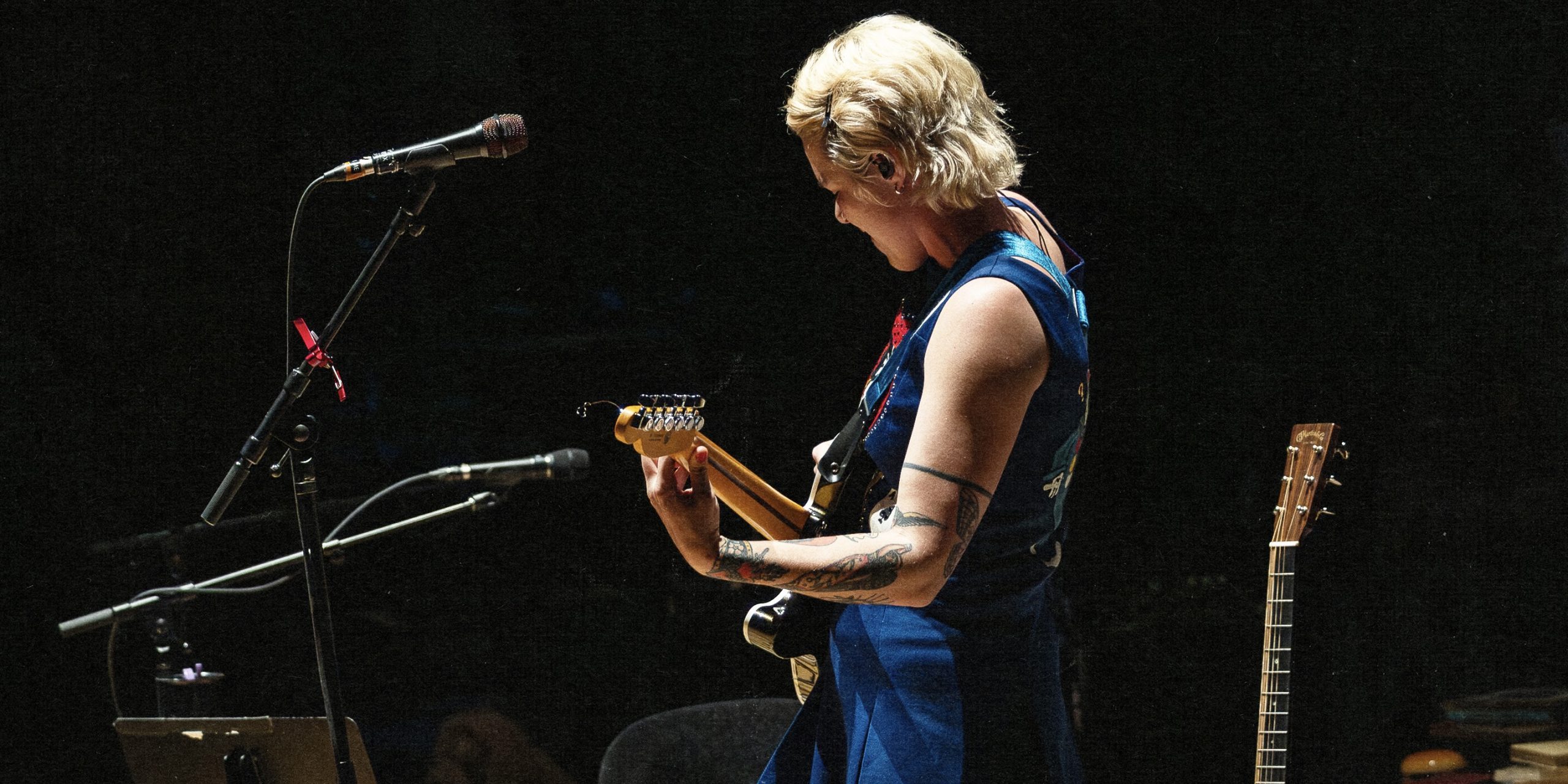
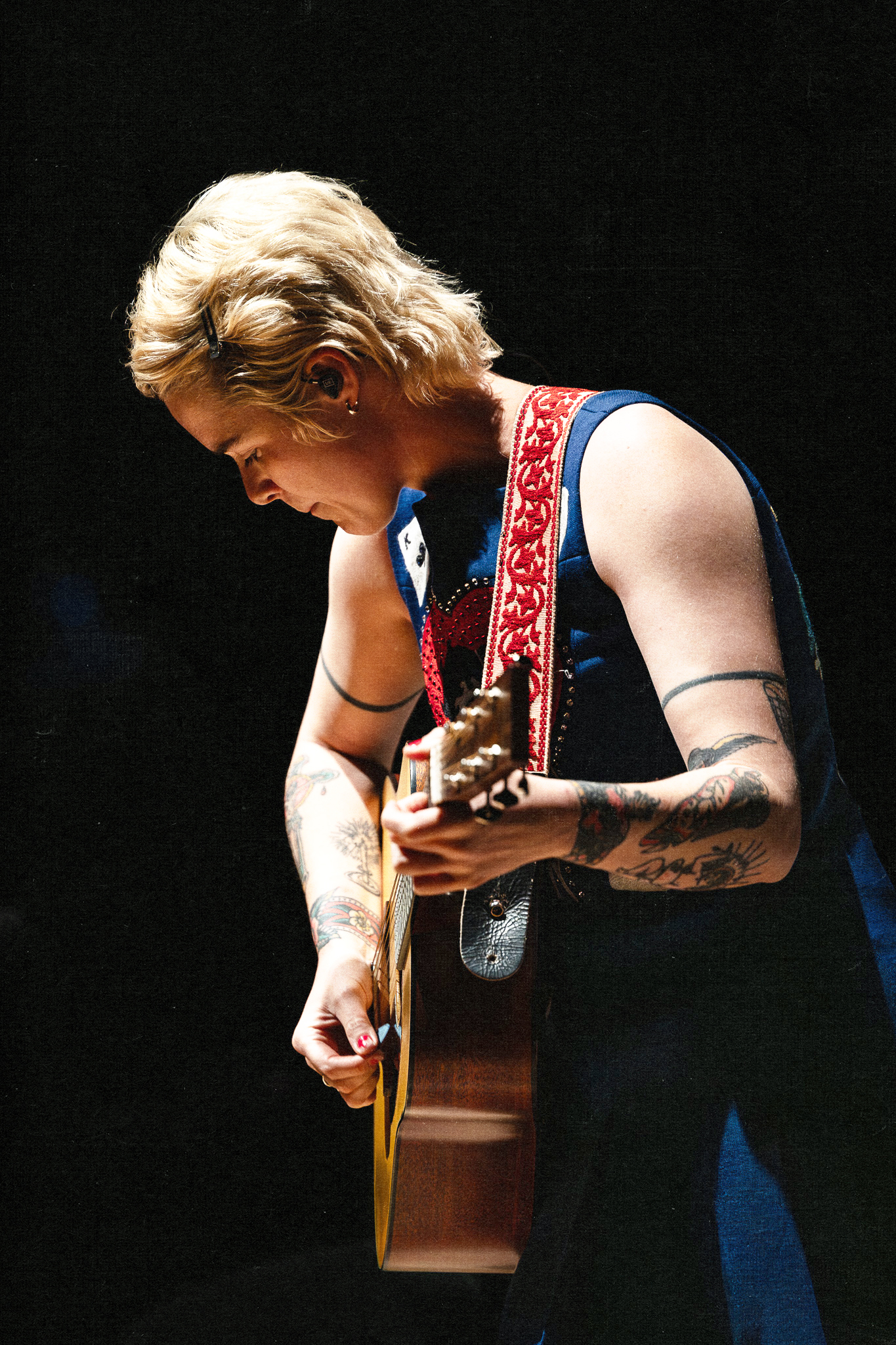
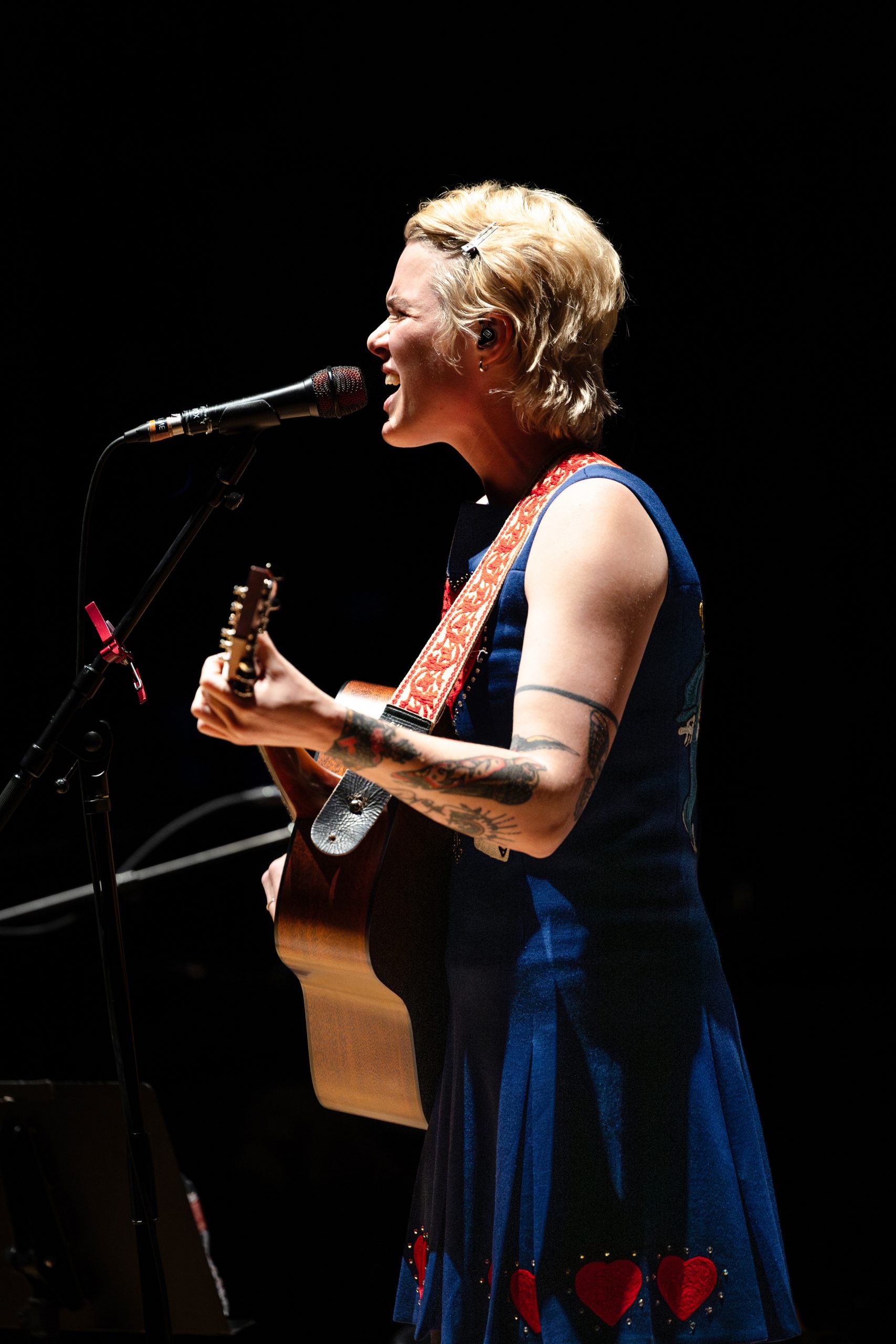
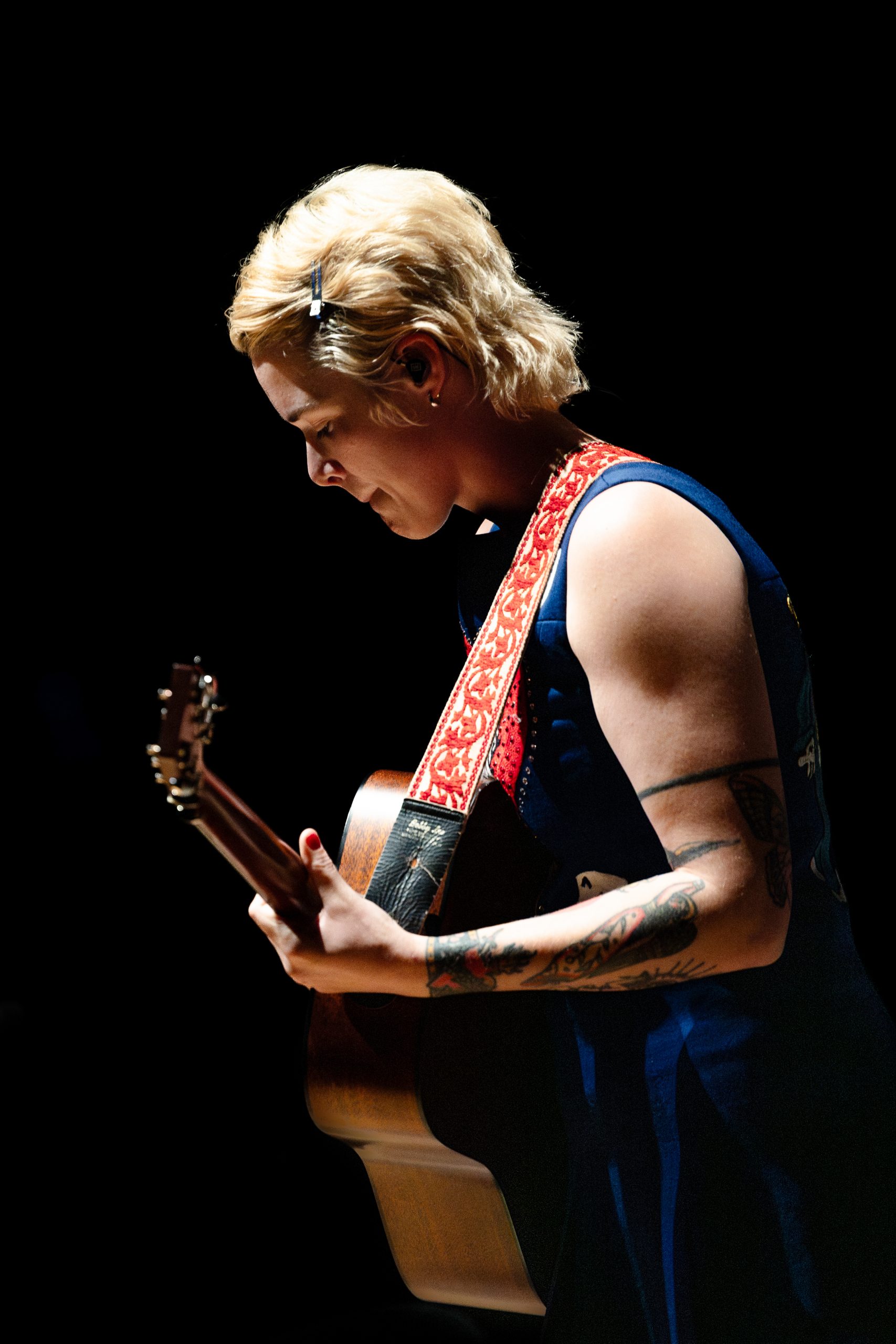
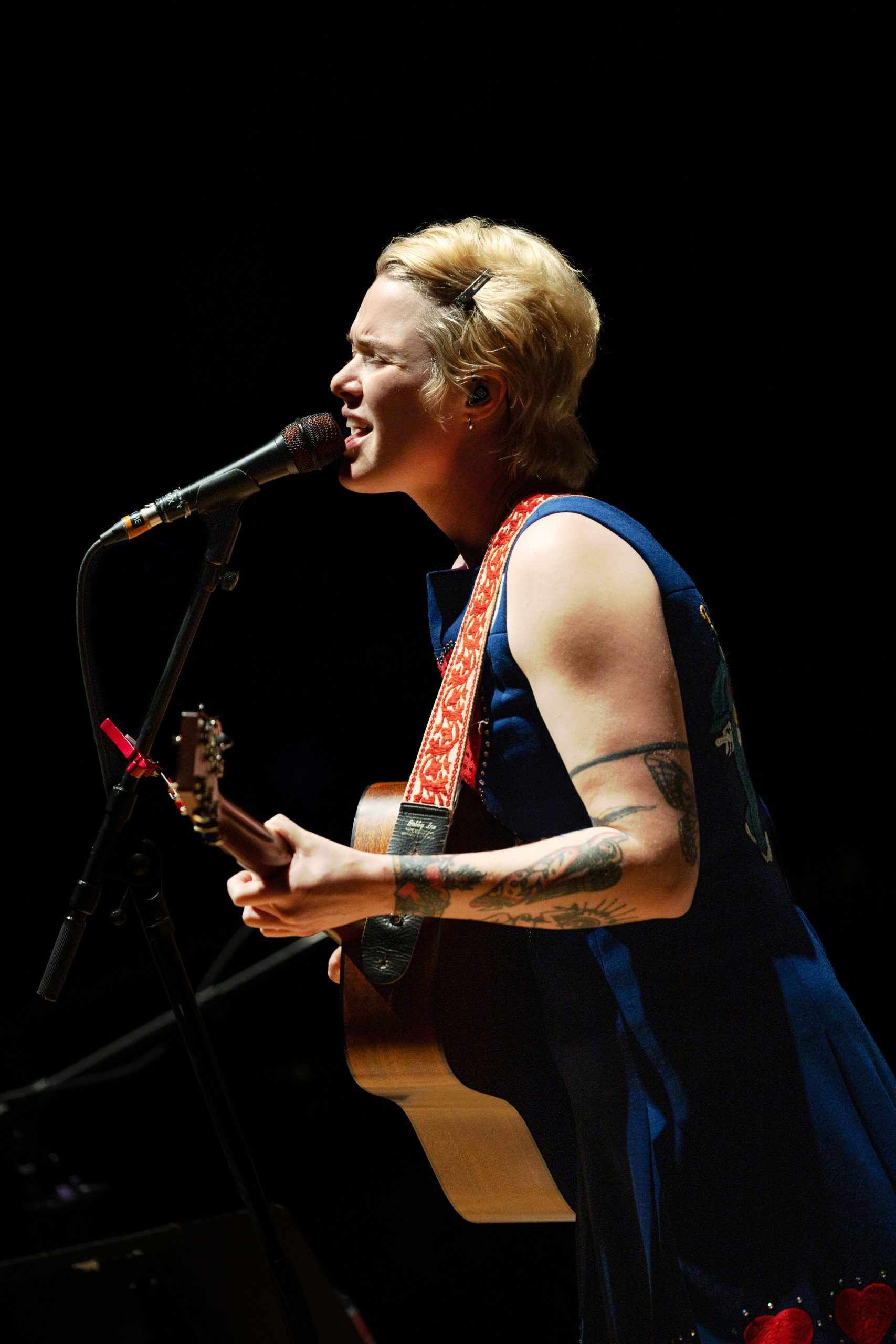
Photos by Dylan Simmons of Brennan Wedl at the Walt Disney Concert Hall (5/6/26).
UCLA Radio’s Rising Artist Spotlight aims to highlight upcoming artists who have demonstrated unique creativity and talent through their music. Through interviews and features, we delve into their journey, influences, and aspirations, giving listeners a glimpse into the future of music.
Brennan Wedl is a Nashville-based singer-songwriter known for her distinct “grungetry” (that is, grunge and country) sound. They recently announced their upcoming album, Brennan Wedl, set to release August 21. Despite only recently signing to ANTI- Records for her self-titled record, Wedl is far from a music industry newbie.
Back in 2016, she co-founded the punk rock, queercore band Dazey and the Scouts, whose singular, angst-ridden album, Maggot, amassed online virality during the COVID-19 pandemic, despite the group disbanding in 2018. Lesser known than The Scouts is Brennan Wedl’s solo project, where they’ve been releasing tracks under their own name since 2019.
Wedl’s solo discography strikes a markedly different chord, distinguished by country influences and their raw, twangy vocals. Still, Wedl’s punk past endures in their personal ethos as well as their music, often incorporating noisy guitar riffs, distortion, and defiant lyricism — hence the “grungetry” label. Featuring production by alternative Americana act Waxahatchee (Katie Crutchfield) alongside indie rocker Snail Mail (Lindsey Jordan) on guitar, Brennan Wedl masterfully interweaves these seemingly opposing influences.
Wedl’s unique persona embodies her multifaceted sound. Her style, sporting a bleach-blonde pixie cut and tattooed sleeves, lends to an intimidatingly cool aura, but her charismatic charm and down-to-earth approachability betray this façade. Both parts cool and authentically kind, Brennan Wedl is well-equipped to become the alt folk scene’s next indie darling.
—
Interviewed by Dylan Simmons on June 16, 2026. This interview has been edited for clarity & brevity.
Dylan Simmons: You recently got off of your tour opening for MJ Lenderman and Waxahatchee, who are your new labelmates at ANTI- [Records]. I was at that last show in LA, which was insane; so good. How’d that tour go for you? How’d that feel?
Brennan Wedl: Oh my gosh, well, thanks for coming to that show. It’s been a month and some change since getting back from this tour, and it was like a magical portal, basically. Like, I do not feel the same as when I started the tour, and just being around Katie and Jake [Lenderman] and their teams– Everyone on that tour is just such a creative force, and just seeing how they conduct rehearsals, business, even just switching up the setlists — watching them fearlessly switch in and out songs just really inspired this spontaneous spark to how a live performance can go, especially a solo live performance. So on this tour, I was experimenting with either talking between songs or just silence, letting the songs do the talking– Just really experimenting with the one-woman show thing that I was opening with, and it was… magic, is the word that sums it up for me. Such a treat.
Dylan: Those sets were so gorgeous, and I loved everyone’s stripped down songs. [Jake and Katie] seemed to have such a mutual respect for you as well. Shouting you out and bringing you out during their set I thought was really sweet, because I feel like that’s not something you see with openers, usually.
Brennan: Totally. I felt so lucky, and just so capable up there. For the first time in my life, I was like, “Yes, this feels really correct. This feels right.” Not the first time in my life, but it just felt very natural, and I was so grateful for that.
Dylan: That’s so awesome. How’d it feel starting to introduce some of your songs on your upcoming record to [that] audience?
Brennan: It took the pressure off, knowing that it was going to be the first time a lot of these people have heard my music, so I definitely met these performances with a less perfectionist attitude than maybe historically I have. Since it’s just me with the guitar up there performing songs that are recorded full-band, [I had] the artistic license to create this moment. I felt like it was very no rules, sing from your heart. The fact that I was going to be new to a lot of these audiences was just a supportive thought in my head. I could be intimidated, like, “Oh, I hope they like me,” but I’d rather put the energy into singing from my heart and just seeing where that lands. Getting out of my head, into my heart.
Dylan: Totally. That’s so cool, having there be no expectations, and getting to introduce yourself so powerfully with that solo performance.
Brennan: I felt so lucky to be able to do it. Loved it. I’ll remember it forever.
—
Dylan: You just toured with Katie for Waxahatchee, and also for Snocaps. How did she contribute to the making of this album?
Brennan: She produced it with Brad Cook. I brought her these songs, and she helped me create this sonic world that was true to myself, true to my roots, and true to who I’m becoming. Having Katie on board as a producer– she has such valuable insight [into] what I can’t totally see, being in the driver’s seat, writing the songs, having horse blinders on. She came in and she was like, “How about this? You released this song three years ago; what if we call it back?” Like, “Let’s stay true to your songwriter roots, but let’s not forget that you are a rocker.” She really helped join the worlds of Americana and punk. She’s a queen.
Dylan: I think your sound is really interesting in that it is, like you’re saying, that blend of almost two different worlds that aren’t necessarily so disconnected — at least not as much as people think. You have [a] much more punk and queercore background with Dazey and the Scouts, and now you’ve kind of gone in a lot more [of an] Americana, acoustic, singer-songwriter direction with some of your first solo stuff. I’m curious what kind of sonic influences you had coming into this album as you’re combining these different worlds.
Brennan: I love, love, love, love the anthemic pop banger that is “Silk Chiffon” by MUNA and Phoebe Bridgers. I wanted things to feel bright, huge, singable, taking the themes of like a catchy, summer feeling– I was really inspired by summertime. These songs are coming out June, July, album in August. Lucinda Williams is one of my all-time faves, so Lucinda is always an angel on the shoulder. Mannequin Pussy — I love that band. Dazey and the Scouts opened for them [when] I was out of town!
Dylan: That’s a crazy crossover. I did not know this.
Brennan: I know. This was probably nine, ten years ago in Boston. I love Mannequin Pussy. They really use music as a vehicle for social justice, and for what they believe in, and community, and I want to have that in my own work. So, Mannequin Pussy, MUNA, Lucinda Williams, PJ Harvey. Summertime, chillin’, sobriety, romance… Those are the references.
Dylan: Me and my friends keep saying this summer, there’s gonna be a healing. That’s kind of what that’s giving to me.
Brennan: I love that.
Dylan: Just like soaking in the sun and serotonin…
Brennan: Yeah. Let there be a healing. Please.
Dylan: Let there actually be a healing. Fingers crossed. Also, yeah, the Mannequin Pussy crossover is crazy– and it’s also so funny because they’re on Epitaph [Records], your sister label [to ANTI- Records].
Brennan: I did not know they were on Epitaph. That’s tea. I love that.
Dylan: Wait, until like now?
Brennan: Yes! That’s so cool!
–
Dylan: I think that’s also something really interesting: this rising grungetry, alt folk wave with Wednesday, Jake, Katie, Geese– a lot of artists like you, but also with so many other distinct sounds. I think it’s interesting how it’s like– I don’t want to say “co-opting,” because I feel like there’s always been a lot of anti-establishment roots in folk and country artists — it’s not just the patriotic, MAGA stereotype that a lot of people think of when they think of country music — but I do think it’s interesting that there is such a strong movement now to more alternative folk scenes, with people that are so outspoken about Palestine and being queer and all these things that seem to be “incompatible” with Southern culture or American culture. I think that’s just a really interesting sentiment, hearing you say that as well, like wanting to have that tie-in of social justice in your art.
Brennan: Totally. You said it so well, that folk music is about sending your message. Storytelling. Punk music is storytelling– It’s all storytelling, and the stories we tell are really important. I’m realizing that more and more, and I think it’s our duty as artists to really be in touch with our hearts and our communities and work together to be the ones that change things. Because we can. The government isn’t gonna save us; we save us.
Dylan: Very true. And music has always been the tool for bringing people together, as long as humans have existed, and that’s what folk music is about. It’s about tradition and community, and I think that’s really cool to like almost [go] against that stereotype of what mainstream country music has become, especially to have more alternative people — AKA not straight white cis male people — telling those stories as well, because it kind of shows like the idea of America shouldn’t be incompatible with queerness and alternative cultures and stuff. This is such a random reference that just came to mind, but I love the movie Brokeback Mountain, because it really subverts the idea of the strong masculine cowboy [with] homosexual men being associated with femininity and the opposite of masculinity– The way that that film kind of subverts those two different identities and shows that these are the same people, we’re all Americans, we’re all cowboys, you know?
Brennan: I love that.
Dylan: It also makes sense, [the] tidbits of noise rock and grunge that like bleed through your songs, even as you’ve taken this more like Americana direction. [Punk and Americana] seem so different, but [they’re] really not.
Brennan: They like merge so well. Seeing a live show with both of those components [is] so cool: full band rocking, and then solo acoustic. It’s chef’s kiss.
Dylan: And I love that both of those things can exist in the same album, much less the same person. Listening to your record, it definitely explores both of those worlds, and I think you guys did a really good job of having that through line and incorporating all those elements in a way that sounds very consistent [and] thematic.
Brennan: Thank you. We set out to find the marriage between punk and Americana, and I’m just so, so happy we found somethin’.
—
Dylan: You mentioned summertime and sobriety being some elements on this album. What other overall themes or images have shaped this album that are not necessarily sonic?
Brennan: I grew up really Catholic…
Dylan: That’ll do it.
Brennan: That’ll do it. [both laugh] …And I think finding my own version of spirituality in these last few years has really influenced this album. Like, ritual, tarot– I’m really influenced by the Major Arcana of the Tarot deck of the Rider–Waite. There is one song [on the upcoming record] called “High Priestess,” and the High Priestess card is about really tuning into and sharpening your intuition, but not being super flashy about it. It’s like nurturing your internal garden. Nag champa incense. The ‘90s country divas: Reba [McEntire], Shania [Twain], The Chicks, Wynonna. I love a country diva. Zines, writing letters, kind of like old school communication. Technology is being freaking forced down our throats, [so] I think I was so inspired by little notes, letters in the mail, even writing in the bathroom stall at the club — I usually don’t add to it, but just like seeing what people are gabbing about — there’s inspiration everywhere in that.
Dylan: For me, that’s also junk journaling and scrapbooking. I love my tactile crafts. I totally feel you on that.
Brennan: Having the physical time stamp of “I was here. This is what we did. This is my life right now.” It’s incredibly inspiring. I love that you do junk journaling.
Dylan: I do a concert journal, too. It’s very fun. I highly recommend keeping like travel journals or tour journals. It’s very tactile and very DIY. Also, weirdly enough, that is something that I picked up from looking at your discography — especially for Dazey and the Scouts, looking at that album artwork, but also your singles artwork from your solo discography. I feel like a lot of that still has that very DIY, mixed-media feel, which I think is really cool. It’s almost like the mixed media of Americana, acoustic, finger-picking, but also like really noisy grunge elements. It’s a collage of an album — I think that’s a good word for it.
Brennan: Thank you for saying it like that. That is totally what I want that to convey. We can do whatever we want creatively. I think sometimes we can kind of put ourselves in boxes of being like, “I actually just do this one thing, and I do it really well, so I’m just gonna stick with it.” We have access to a creative ocean, and bringing the mixed media to the table will only make you happier.
Dylan: The most artistic and creative people I know in my life are all not confined within those genre boundaries or artistic boundaries, and I think that’s so cool. Why limit yourself to some arbitrary definition of what a genre or what a medium has to be?
Brennan: Amen.
–
Dylan: I know some of the songs on this upcoming self-titled album have already been released as singles in the past, but it sounds like all of them have been re-recorded for the album. How did the overall recording process go? Did you find that any of your older songs changed significantly? And over what span of time did you write these songs?
Brennan: I think the oldest song is probably “Scorpio.” I started writing it like eight years ago, and that’s the song that I have the most versions of. There’s like four to five different studio recordings of “Scorpio.” I think [in] bringing back some of the singles, our intent was I didn’t want them to live in singles world forever; I wanted them to live in a body of work. So they aren’t super different at all, but they live in the same world as the self-titled album. I love both versions so much. And just the creative freedom to say, “F*ck it, let’s do a new version of this old song,” was something I didn’t realize I could do. Katie was like, “Have you ever thought about bringing some of these old ones back?” And I was like, “No, but I like this idea.” So their titles are now like “Scorpio (Album Version),” “Fake Cowboy (Album version).” The old ones will still live online, because I love them, and they’re absolutely a part of my artist journey. I can’t imagine taking those away, because they’ve been out for so long, but it’s just like a creative exercise to see how we can reframe these old songs to put them in this new album. It was really fun.
Dylan: That makes perfect sense, and especially for this being your self-titled album, too. I don’t think it’s at all thematically off-base to bring back old songs and be like, “This is me, over a span of years,” and seeing those changes in your solo artistry throughout the album itself.
Brennan: Totally. I think there’s a few years difference in between the recordings of “I Wanna Be Your TV” and “2 Dollar Pistol,” et cetera. So hearing the time pass through the different versions is time travel, personally.
Dylan: Totally. I’m sure it feels so personal, too.
Brennan: Yeah, it does. I’m not usually one to dwell too hard on the past, but in this instance, it was a great practice in editing, coming back to something — nothing’s ever really done. It was fun.
—
Dylan: Why do you feel like this album is different? Why is this your self-titled album, and you reintroducing yourself as an artist?
Brennan: I feel that these songs accurately represent what I’m trying to do right now, songs that are so meaningful to me, songs that were written almost ten years ago, still finding their way into my setlists. I picked songs that definitively express who I am right now, and so maybe if I could rename [the album], it would be like, Brennan Wedl, Right Now, in like an alternate universe, but not in this universe, because I don’t know if [it] would be a good album name… [laughs]
Dylan: That is kinda funny, though. I like that.
Brennan: It just felt right to be like, “This is who I am; I’m gonna name it my name.”
Dylan: Totally, yeah. It definitely showcases your style and your writing really well, and also just that range of sounds like we’ve been talking about. I’m so excited for this to be out. I’m sure you are, too. Are you scared, or are you just excited?
Brennan: I’m just so happy that it’s coming out over the course of the summer. I love that. I am not nervous for it to be out; I’m so ready. It’s been a slow and steady type beat for the last few years. It can be overwhelming sometimes, being like, “Oh shit, it’s coming out now, here we go.” So maybe that’s what makes me nervous, just like the wave of full circle moments, and excitement, and just the life lessons that come with putting something out. Learning about yourself when you show something to the world — those can be intense lessons, but I want to learn them. I want to learn.
—
Dylan: I’ll end with the recent announcement that you’re going to be opening for Snail Mail and Soccer Mommy.
Brennan: I love them!
Dylan: How do you feel about that? Are you excited [to be] going on that [tour] after your new album comes out?
Brennan: I’m so excited to rock. It’s rock night; that’s the rock tour.
Dylan: Yeah, that’s gonna be so cool.
Brennan: I’m really excited. So grateful.
Dylan: My friend called it the “lesbian Super Bowl.”
Brennan: And that it is. [both laugh] That’s so awesome. It’s gonna be epic.
Dylan: That’s gonna be awesome. I’m so excited for you, [it’s] such a big year for you.
Brennan: Thank you so much!
–
Listen to Brennan Wedl’s first single, “Pretty Little Fantasy,” off their upcoming album due August 21!
Check out Brennan Wedl and more on our Rising Artist Spotlight playlist!