
Photos courtesy of Laurie Kilmartin
Laurie Kilmartin is a comedian and writer whose stand-up finds light in dark topics and always makes a crowd burst into laughter. She was a monologue writer for CONAN on TBS for its entire on-air run and is currently in the writer’s room at Jimmy Kimmel Live! If you have ever wanted to take advantage of the comedy scene in Los Angeles, catch Laurie at the Elysian Theater on May 16th.
This interview has been edited for clarity and brevity.
Amanda Romankiw: I was inspired to talk with you because I watched a lot of late night growing up, but it wasn’t until I started watching CONAN on TBS that the monologue became my favorite part. Before we jump into your career, can you talk about your experience at UCLA when you attended?
Laurie Kilmartin: I ended up dropping out. I had an eating disorder in high school, and I guess I had pinned all my hopes on moving, but everything got worse. When I dropped out, it was temporary. I was just going to get my shit together and go back. Then I fell into stand up and went in a different direction. I always want to go back to school. Maybe when I’m 80, I will go back and be one of those elderly people that graduates.
AR: Were you involved in comedy at UCLA, or was that something you developed a love for later in life?
LK: I remember seeing a stand up at UCLA at a place for students, and the comedian was not good. I remember thinking that was stand up comedy and having no desire to do it. But then later in the Bay Area, when I was figuring out my life, I started going to stand up and just having a desire to try. I was a drama major at UCLA, so maybe that was part of that interest in performing.
AR: After UCLA, you moved to San Francisco. What was the stand up culture in the Bay?
LK: It’s weird. I moved back home to Walnut Creek, and then I would drive into the city every single night and do stand up. I started with Margaret Cho and Greg Behrendt, who wrote this book called He’s Just Not That Into You. We all started together in the very late 80s, and it was really fun. There was this one room in San Francisco called the Rose and Thistle. It was open seven nights a week. If you weren’t at the big clubs, you got to work out there all the time.
AR: Who were your comedic inspirations growing up? Have they changed over time?
LK: When I was growing up it was Carol Burnett. She was on every Saturday night. It was an incredible show I would watch with my mom. She really made my mom laugh, and I think that was sort of what I wanted to end up doing — getting a laugh from my mom. She would be my big inspiration. She did a little monologue up front. I don’t know if you’ve ever seen it, but she would take questions from the audience. It was almost like the first version of crowd work.
AR: From what I can imagine, it takes a lot of courage to stand up in front of a crowd and perform jokes you wrote while not knowing how they’re going to respond. Especially when you were starting out, how did you approach these nerves, and would you say it’s gotten easier over time?
LK: It’s way easier. I just have so much experience now that I know if a joke doesn’t work, it’s fine. I shrug it off. But when I first started, I was like, Am I funny? If your joke doesn’t work, you’re like, I should die [laughs]. You go through all this stuff in your head, and it’s really hard. It takes a couple of years to overcome.
AR: In 2024, you released your special titled Cis Woke Grief Slut. Something so admirable about your comedy is your ability to draw humor from serious topics. You even went viral on Fox News when Sean Hannity was bashing you about an abortion joke you made. What draws you to this style of dark humor, and why do you think audiences are so receptive to it?
LK: I don’t think they’re all receptive to it [laughs]. But that’s the kind of stuff that makes me laugh. I think as a stand up, I want to do stuff on stage that if I were in the audience, I would be like, Oh my god, I love this person. So I hope I connect with people in that way. I guess I naturally have a dark way of looking at life, and the longer you live, the more tragedies happen to you, and you have more opportunities to go: Can I handle this death with a joke? Okay, let me give it a shot. To me, it’s always a challenge. If it’s a tricky topic, can I get a laugh out of it? Not like an applause, but an involuntary laugh.
AR: In a LA Times article, you said, “Men get into stand-up to get laid, and women get into stand-up to be heard.” What was it like navigating such a male-dominated industry in the late 80s?
LK: I mean, what I love about the female comics that are starting now is they don’t put up with as much shit as we did. I honestly didn’t think I had a choice. You were really on your own, and you needed to be on guard on the road. A lot of times, they would put us in condos, and they hardly ever booked women together. It was just a lot of putting up boundaries, returning to your room, and not putting yourself in a position where something bad could happen to you.
AR: You were a monologue writer for CONAN for about 10 years. How did you two first cross paths and start working together?
LK: I tried to get on Conan as a staff writer when he was doing late night in New York back when he was on The Tonight Show. I did a couple of different packets, and then The Tonight Show ended. When he started the TBS show, I did another packet. A “packet” is when you submit to a show, like a sample. For late night, you need to prove you can write in the voice of the host. It needs to be current, topical material. The thing with late night is you have to produce a lot of material. About 95% of it does not get on the air, but you have to provide it. It’s a volume business every single day.
AR: I don’t know if you know, but there’s a two-hour compilation of you getting screen time on CONAN. When you started writing the show, did you expect to have that much on-screen presence?
LK: I was always willing to do it. I was on the monologue side, and that was more time-intensive. We always had X amount of jokes due in an hour, so sometimes I couldn’t put on a nurse’s uniform for a skit, which I would have loved to do. I didn’t have as much flexibility as the sketch writers. They would throw me in stuff, and I would always love to do it. It was so fun, and you get a little extra money [laughs].
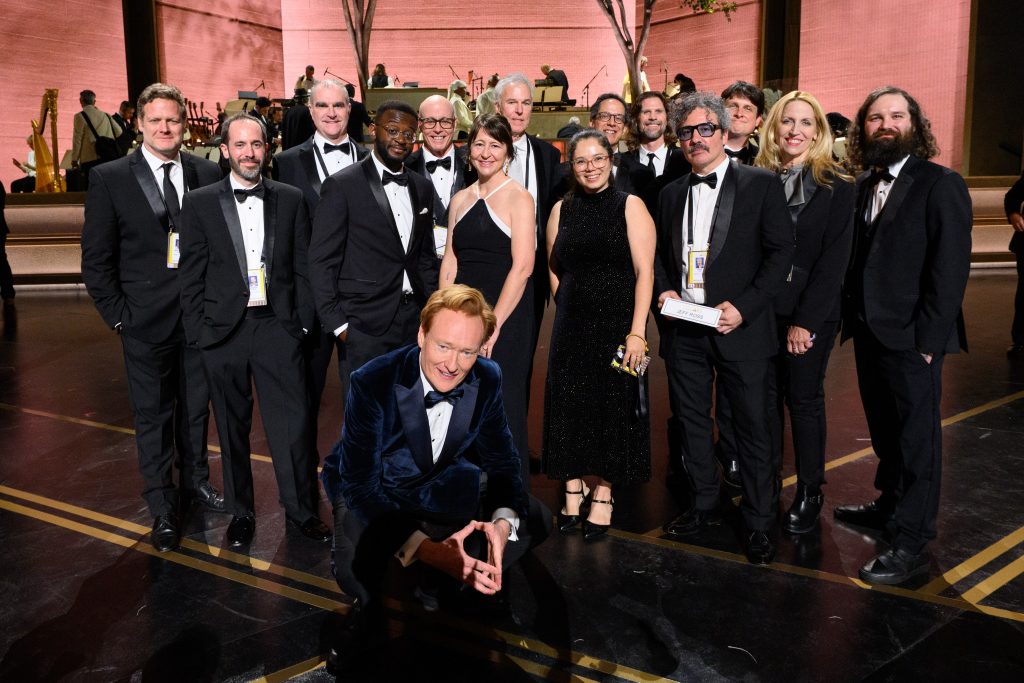
AR: You worked on the Academy Awards with Conan for the past two years, which is probably the biggest night in entertainment. How did you get brought on to these projects?
LK: When Conan got the job, he wanted to reassemble his old staff. The first year, I wasn’t working, so I was available. The second year, I was working at Jimmy Kimmel, but they let me take a hiatus to work on the Oscars. Jimmy and Conan are really good friends. So I was very grateful they let me do that, because working on the Oscars is so fun.
AR: I love your story about Ariana Grande and how you thought she was a stand-in.
LK: Oh, my god [laughs]. I didn’t expect to see Ariana Grande because at rehearsals, there were stand-ins pretending to sing. When Ariana Grande started to rehearse for the Wicked performance, I was like, God, that girl looks exactly like Ariana Grande. And then I was like, Oh, that’s really her.
AR: When you’re starting to prepare for the Oscars, it’s months in advance. Given how fast-paced current events in pop culture are, what’s your team’s process for keeping a beat on these jokes and predicting what will work months out?
LK: The jokes are not that topical because they’re about the movies. I think our problem was trying to figure out, even after the movies were nominated, who has seen what. If you haven’t seen the movies, you can’t complain about not getting the jokes about the movies. As we got closer to the actual Oscars, we could start to drop in some topical stuff. We had been looking at the same premises for months at this point, and to have Timothée Chalamet say something dumb right before the Oscars, we all just went nuts.
AR: I recently watched a docu-series about SNL, and I thought it was just so shocking how intense the writer’s room was. What does a typical day look like in the writer’s room at late night?
LK: It’s different for different shows. For the Oscars, we would all meet at Conan’s office in Larchmont and just talk. Sometimes Conan would interrupt the meetings, and then we would just shoot the breeze for hours. If you’re writing in January for March, the urgency is a little different than if you’re writing at 7:00 a.m. for a show that tapes at 4:30 p.m. that night.
AR: Monologue versus stand up writing is very different because you’re writing in somebody else’s voice. Do you find one more difficult or enjoyable than the other?
LK: You think they wouldn’t be that different, but they really are. I became a better stand up after I started writing for Conan and now Jimmy, because the discipline of writing every single day trains your brain to keep writing all the time.
AR: What advice would you give to young people looking to pursue a career in entertainment?
LK: The way you guys are going to do it is different from how we did it. I tell my son everything is so fucked anyway, you might as well just go for it and see what happens. People crave good stuff. If you’re smart, funny, and can write great drama, people love it.
AR: Do you have any upcoming shows or projects you’re looking forward to?
LK: There are always shows in LA. I’m workshopping my hour on May 16th at the Elysian Theater in Los Angeles. If anyone’s around at the Elysian Theater at 4:00 p.m., come to the show!